
Here is an uncomfortable truth that every implant team in India knows: two children can receive the same implant, from the same surgeon, in the same month — and two years later one is chatting in full Gujarati sentences while the other responds only to his name. The device is almost never the difference. The therapy is. After a family has spent several lakhs on surgery, auditory verbal therapy is the part that decides whether that money becomes spoken language or just awareness of sound.
Why does a perfectly working implant still need therapy?
The implant solves a hardware problem — it carries sound past a damaged cochlea to the hearing nerve. But the brain of a child who has never heard receives that signal as meaningless noise, the way written Gujarati looks to someone who has never learned the script. AVT is the systematic process of teaching the brain to detect sounds, tell them apart, attach meaning to them, and finally understand and produce speech. No processor setting can shortcut that learning, just as no better pair of spectacles can teach a child to read.
What actually happens in an AVT session?
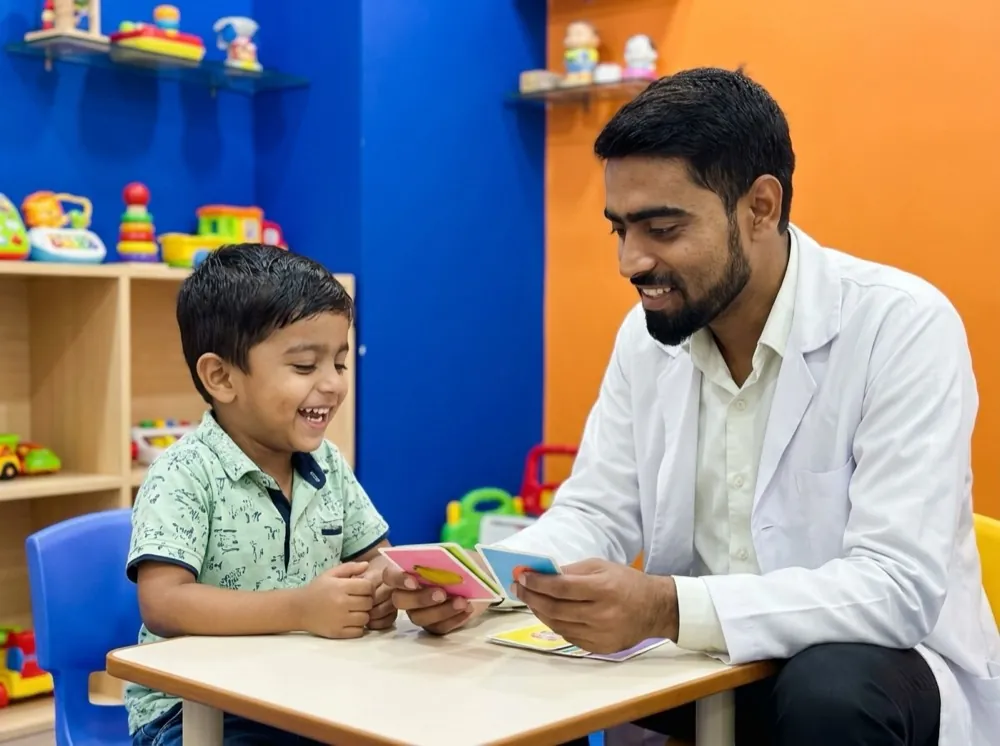
An AVT session looks deceptively like play — and that is the craft of it. The therapist sits beside the child (not opposite, so the child listens rather than lip-reads), and runs games where every toy and turn is engineered around a listening goal: responding to the “Listening Six” sounds, picking the spoon when asked without any pointing, following two-step instructions hidden inside pretend cooking. Crucially, the parent is in the room the whole time, because the real client in AVT is the parent. The therapist demonstrates a technique, the parent tries it, the therapist refines it — and the family leaves with specific homework, not vague advice to “talk more”.
What is the parent’s daily role at home?
AVT assumes roughly 30–60 minutes of deliberate listening practice spread through the day, folded into ordinary life: narrating while hanging clothes, making the pressure cooker whistle a listening game, saying the word before showing the object, pausing expectantly instead of prompting. Grandparents and siblings count too — a household that talks to the child, in the language it genuinely speaks at home, is the therapy machine. Our guide to speech therapy exercises you can do at home pairs naturally with AVT homework, and our speech milestones by age chart helps families track whether listening age is translating into language.
How long does AVT continue — and what does progress look like?
| Stage | Typical period after switch-on | What the child is learning |
|---|---|---|
| Detection | 0–3 months | Noticing sound exists — turning to name, stilling at a drum |
| Discrimination | 2–6 months | Telling sounds apart — long vs short, loud vs soft |
| Identification | 4–12 months | Matching sounds to meaning — picking objects by name alone |
| Comprehension | 8–24 months | Following conversation, answering questions, first sentences |
These bands overlap and vary with the age at implantation and the consistency of practice — treat them as a map, not a deadline. Most young children need one to two years of regular AVT; some need longer, especially if implanted late. The dangerous month is around month four or five, when novelty fades, travel feels tiring and the child “responds to sounds anyway” — the point where families quietly stop coming.
A pattern we see often at our Gandhinagar clinic: a child implanted in a metro hospital comes home to Gujarat, attends therapy for three or four months, and then the sessions fade out — distance, school, a new sibling. The family returns when the child is five because school has flagged his speech. The implant is working perfectly; the listening brain simply stopped being trained. Progress restarts, but every skipped month is bought back slowly, which is why we structure auditory verbal therapy for cochlear implant children in Gandhinagar close to home, with online sessions to bridge travel weeks, so the programme never breaks.