
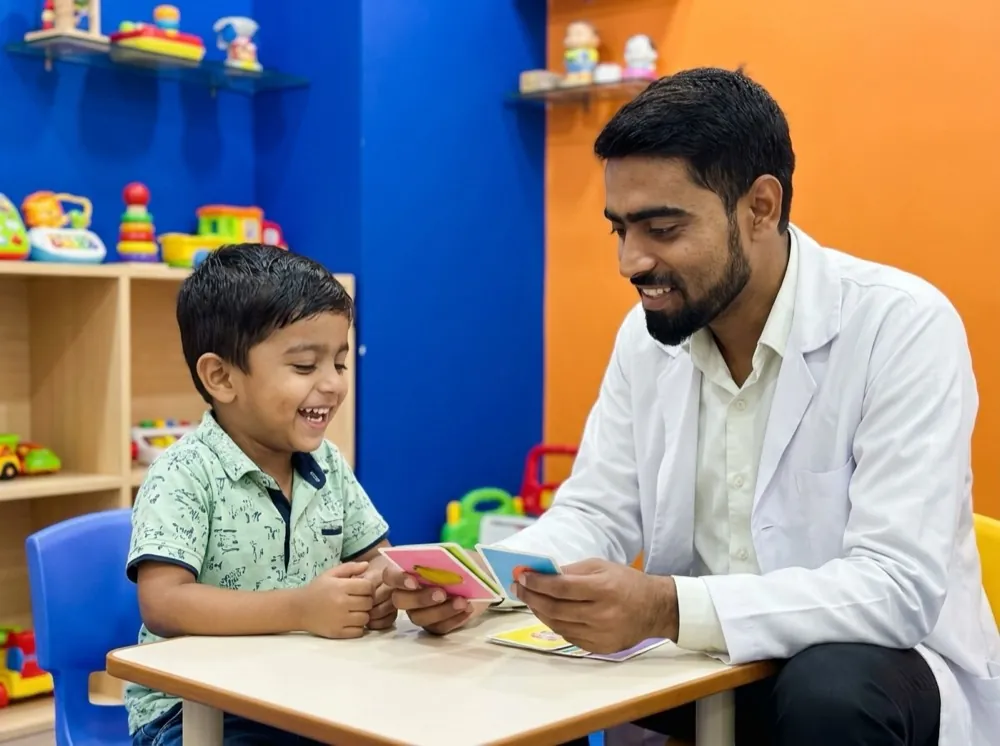
“His cousin spoke at one and a half; he is two and barely says ten words — should we worry?” We hear a version of this question almost daily. The honest answer is that speech development has a wide normal range, but the range has edges. This checklist walks through what typically happens from 6 months to 5 years, and — more importantly — the red flags at each stage that separate “wait and watch” from “get assessed now”.
What should a baby do between 6 and 12 months?
This stage is about listening and pre-speech. By 6–9 months, expect babbling with consonants (“ba-ba”, “da-da”), turning towards sounds and voices, and laughing aloud. By 12 months, most babies respond to their name, use gestures like waving or raising arms to be picked up, and may say one or two real words. Red flags: no babbling by 9 months, no response to name or loud sounds by 12 months, or a baby who is unusually “quiet and good”. These point first to hearing — a hearing test, not waiting, is the correct next step, because a child who cannot hear speech cannot learn it.
What are the milestones from 1 to 2 years?
Expect first words around 12–15 months, roughly 10–20 words by 18 months, and a vocabulary burst toward 50 or more words by age 2, along with two-word combinations: “mumma pani”, “daddy ja”. Understanding runs ahead of speaking — an 18-month-old should follow simple one-step instructions like “ball lao” without gestures. Red flags: no words at all by 16–18 months, no two-word phrases by 24 months, not pointing to show you things, or not following simple instructions. A child who understands well but speaks late has a different outlook from one who neither understands nor speaks — an assessment distinguishes the two.
What changes between 2 and 3 years?
Vocabulary grows from dozens to hundreds of words, and two-word phrases stretch into three- and four-word sentences. By 3, a stranger should understand at least half of what the child says, and the child should ask simple questions and name everyday objects and family members. Red flags: still mostly pointing and pulling instead of speaking, speech that even parents struggle to understand, echoing your sentences instead of answering them, or loss of words the child previously used. That last one — regression — is never “wait and watch” at any age; assess immediately.
What should a 3 to 5 year old say?
By 4, expect full sentences, “why” questions all day, short story-retelling and speech that outsiders understand most of the time. By 5, conversation flows: past and future tense, counting, narrating what happened at school. Some sounds — r, s, l blends — may stay imperfect until 5–6, which is normal. Red flags: a 4-year-old whom strangers mostly cannot understand, sentences of only two or three words at 4, stammering with visible struggle or frustration, or a child who avoids speaking situations altogether. Our guide on signs a child needs speech therapy covers these signals in more depth.
| Age | Typical milestones | Red flag — assess now |
|---|---|---|
| 6–12 months | Babbling, responds to name, gestures | No babbling by 9 months; no response to sound by 12 months |
| 12–18 months | First words, follows simple instructions | No words by 16–18 months; no pointing |
| 2 years | 50+ words, two-word phrases | No two-word phrases by 24 months |
| 3 years | Short sentences, 50% clear to strangers | Mostly gestures; parents cannot understand; any regression |
| 4–5 years | Full sentences, stories, conversation | Strangers cannot understand; struggling stammer; avoids speaking |
Which red flags mean “get assessed now” at any age?
Four signals override every “boys talk late” reassurance: regression (losing words or skills already gained), no response to sound at any age, no pointing or shared attention by 18 months, and parents unable to understand their own child at 3. None of these is a diagnosis — but each one earns a proper evaluation, usually starting with a hearing test (PTA or BERA, Rs. 300–800 and Rs. 1,500–3,500 respectively), because undetected hearing loss is the most fixable cause of delayed speech. If social communication is also a concern, our post on speech delay versus autism explains how professionals tell the difference.
A pattern we see often at our Gandhinagar clinic: parents arrive when the child is past 3, having been told for over a year that “he will speak when he is ready”. The child usually does start speaking — but therapy that could have begun at 2 begins at 3.5, and the catch-up is slower. Early assessment costs one visit; late assessment costs months.
What can you do at home meanwhile?
Talk through your day in short sentences, in whichever language comes naturally. Read picture books daily and let the child turn pages. Pause and wait after you speak — children need silence to fill. Cut background TV, and keep screens minimal below age 2. And if anything on the checklist above is missing, book a child speech therapy assessment in Gandhinagar — or simply WhatsApp us on 88776 72821 with your child’s age and what you are noticing. We will tell you honestly whether it sounds like normal variation or needs a look.
Book a child speech assessment