
When an elderly parent starts turning the TV louder and answering questions slightly off-topic, most Indian families treat it as normal ageing — something to adjust around, not treat. The dementia research of the last fifteen years says otherwise. If there is one article you share with a reluctant elder this year, let it be this one.
What did the Lancet Commission actually find?
The Lancet Commission on dementia prevention — the most cited review of what raises and lowers dementia risk — ranks hearing loss in midlife (roughly ages 45 to 65) as one of the single largest modifiable risk factors for dementia, attributing around 7 to 8 per cent of dementia cases worldwide to it. That is larger than the share attributed to smoking, depression or physical inactivity. The word that matters is modifiable: unlike age or genes, hearing loss is something a family can actually act on, and the Commission explicitly recommends hearing aids as part of dementia risk reduction.
How can a problem in the ears affect the brain?
Researchers point to three overlapping mechanisms, and all three make intuitive sense once you watch a person with untreated hearing loss for a day:
- Cognitive load. When speech arrives muffled, the brain spends enormous effort just decoding words — effort stolen from memory and thinking. Straining all day, every day, for years is exhausting for the brain.
- Brain shrinkage from under-use. Hearing areas of the brain that stop receiving clear sound begin to weaken, and imaging studies link untreated hearing loss with faster loss of brain volume.
- Social withdrawal. This is the one families recognise instantly. The person who once dominated family gatherings goes quiet, skips the satsang, avoids phone calls — because conversation has become embarrassing work. Isolation is itself a major dementia risk factor, so hearing loss feeds the problem twice.
How much does the risk rise as hearing drops?
The most quoted long-term data, from Johns Hopkins researchers who followed adults for over a decade, found that dementia risk climbed step by step with the degree of untreated hearing loss:
| Degree of untreated hearing loss | Approximate dementia risk vs normal hearing |
|---|---|
| Mild (misses soft speech, asks for repeats) | About 2 times higher |
| Moderate (TV loud, struggles in groups) | About 3 times higher |
| Severe (follows only loud, face-to-face speech) | Up to 5 times higher |
These are population-level associations, not a personal prediction — an individual with hearing loss is not destined for dementia. But notice where the risk starts climbing: at mild loss, exactly the stage most families dismiss as “he hears when he wants to”.
Do hearing aids really protect the brain?
The strongest evidence yet came from the ACHIEVE randomised trial published in The Lancet in 2023: in older adults at higher risk of cognitive decline, those fitted with hearing aids and given proper counselling showed about 48 per cent slower cognitive decline over three years than those who were not. No honest clinician will promise that hearing aids prevent dementia — the science is not there yet. What we can say is that treating hearing loss removes a major modifiable risk factor, restores stimulation to the brain's listening pathways, and — most visibly — brings people back into conversation. For practical guidance on choosing devices for seniors, see our guide to hearing aids for the elderly.
How do you convince a reluctant parent?
A pattern we see often at our Gandhinagar clinic: the family has pleaded for two years, the elder insists his hearing is “fine for my age”, and what finally moves him is not the hearing argument but the brain argument — a son or daughter showing him that hearing care is now considered memory care. Framing matters: this is not about admitting weakness; it is a routine brain-health check after 60, like checking sugar and blood pressure. Start by learning the early warning signs in our article on signs of hearing loss in elderly parents.
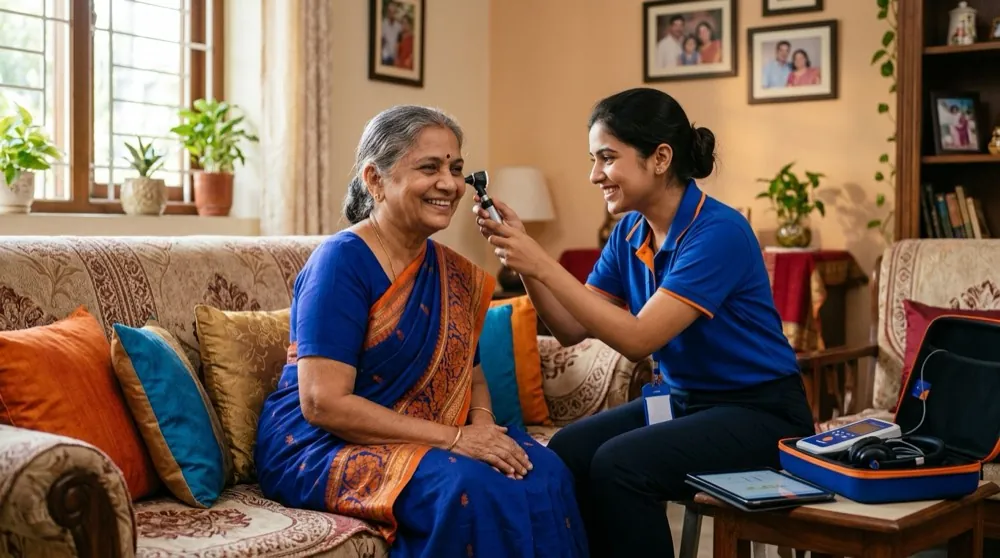
And if the clinic visit itself is the barrier — knees, transport, or plain stubbornness — bring the test to the armchair. We regularly conduct a calibrated home visit hearing test in Gandhinagar for exactly these families: full assessment, same-day report and honest advice, at home, with no pressure to buy anything.
WhatsApp us to arrange a home hearing test