
Nobody announces their hearing loss. Least of all our parents. Age-related hearing loss (the medical name is presbycusis) arrives so gradually — a decibel or two a year — that the person living inside it genuinely believes the world has changed, not their ears. The TV engineers made the dialogue softer. The grandchildren talk too fast. The daughter-in-law mumbles. If you are the adult son or daughter watching this from across the dining table (or across a phone line from another city), this article is for you.
Why do elderly parents hide hearing loss?
Three reasons come up again and again. Pride: for a generation that values self-reliance, admitting a weakness feels like surrendering independence. Fear of the label: hearing aids, in their minds, mark a person as old or weak — an image decades out of date. And genuine unawareness: because the loss is gradual and high-pitched sounds fade first, they truly do hear — they just do not hear clearly, so “my hearing is fine, people should speak properly” feels completely true from inside. Arguing rarely works. Observation, followed by an easy, dignified test, does.
What are the 10 signs to watch for?
- 1. The TV volume war. The most universal sign. If the volume number has crept from 12 to 25 and the neighbours can follow the serial, take note.
- 2. “What? Haan? Repeat that.” Asking for repetition several times a day, especially for names, numbers and unfamiliar words.
- 3. Blaming everyone for mumbling. The signature of high-frequency loss — they hear voices but miss consonants, so speech sounds like muttering.
- 4. Withdrawing from family conversations. Watch them at the next family dinner: nodding politely, laughing a beat after everyone else, then drifting to the balcony. Group talk is the hardest listening situation of all.
- 5. Missed phone calls and doorbells. Both ring at the high pitches that fade first.
- 6. Phone calls on speaker, pressed hard to the ear, or handed to someone else. One-ear listening exposes a loss that face-to-face talk hides.
- 7. Wrong answers to simple questions. You ask about lunch; they answer about Mohan. Mishearing, not memory, is often the culprit.
- 8. Turning one ear towards the speaker or watching lips intently — unconscious compensation.
- 9. Exhaustion after social events. Straining to decode speech all evening is genuinely tiring; if weddings now “give them a headache”, listening effort may be why.
- 10. Louder speech and complaints of ringing. People unconsciously raise their voice to hear themselves; tinnitus often travels with hearing loss.
One or two of these occasionally is normal life. Four or five, week after week, is a pattern worth testing.
Why does “everyone mumbles” actually mean it’s their hearing?
Presbycusis takes the high frequencies first — and in speech, high frequencies carry the consonants: s, sh, t, k, p, f. Vowels, which sit lower, survive. So your parent hears the shape of every sentence at normal loudness but loses the edges that make words distinct — “baat” and “saat” blur together. From inside, that experience is precisely “people are mumbling.” It is also why shouting does not help (it distorts) while speaking slightly slower, facing them, helps a lot. If your parent also has diabetes or high blood pressure, the odds rise further — we explain why in how diabetes and BP quietly damage hearing.
Why is waiting a bad idea?
Untreated hearing loss is not just an inconvenience. Research links it with social isolation, low mood, and faster cognitive decline in older adults — a brain that spends its energy straining to decode sound has less left for memory, and a person who stops joining conversations loses the daily mental exercise that keeps them sharp. There is also a practical reason not to wait: hearing aids work best when the brain still remembers how to process speech. The longer a loss sits untreated, the longer the adjustment when amplification finally arrives.
| Degree of loss | What it looks like at home | Typical next step |
|---|---|---|
| Mild | Misses soft speech and whispers; TV slightly louder; trouble in noisy rooms | Baseline test, yearly monitoring; communication tactics |
| Moderate | Frequent repetition requests; phone difficulty; withdraws in groups | Hearing aid fitting usually recommended |
| Severe | Follows speech only when loud and face-to-face; doorbell and phone often missed | Hearing aids essential; family communication training |
| Profound | Little response even to loud voices | Power hearing aids; implant options discussed |
A pattern we see often at our Gandhinagar clinic: the family is convinced their father has “selective hearing” — he catches market gossip but misses requests from across the kitchen. The audiogram almost always explains it: low-pitched, face-to-face speech in quiet still gets through, while softer, high-pitched or distant speech does not. It was never about attention or attitude — and watching a parent be vindicated by a graph, while the family quietly re-reads every “ignored” conversation of the past two years, is a moment we never tire of.
How does a home-visit test remove the biggest excuse?
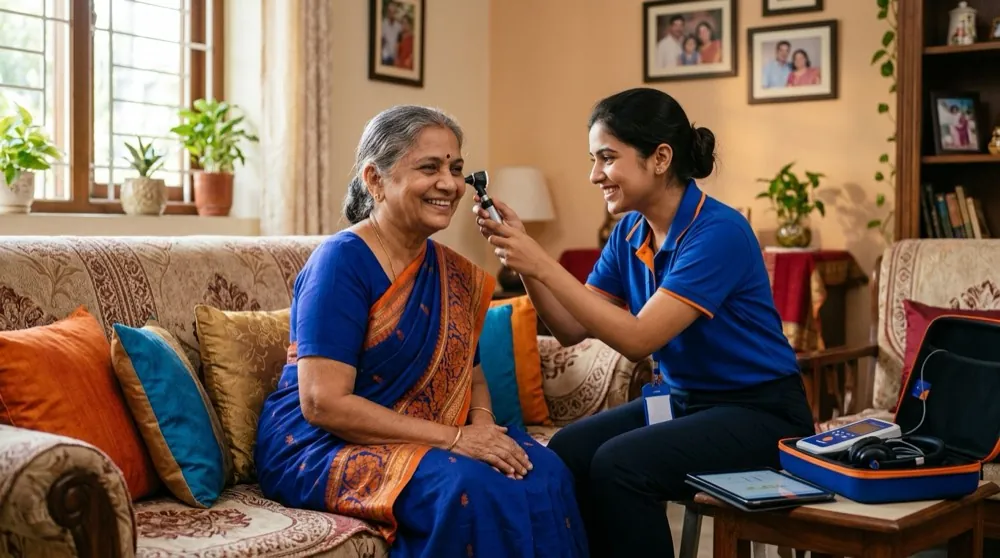
In our experience, the single biggest barrier is not denial — it is the trip. Travelling to a clinic, waiting, being examined: for a knee-pain-afflicted 75-year-old it is a half-day expedition, and refusing it is easy. A home-visit hearing test in Gandhinagar removes that excuse entirely: our audiologist brings calibrated portable equipment to the house, checks the ears for wax, runs pure tone audiometry in a quiet room, and explains the result to the whole family over tea. The test costs roughly Rs.300–800 and takes about an hour. Frame it gently — “a routine check-up, like your BP” — and let the audiologist do the convincing. To arrange one, WhatsApp us on 88776 72821 with your area and a convenient time.
What happens after the test?
Sometimes the answer is delightfully simple — impacted wax, removed in minutes. Where the test confirms age-related loss, the next conversation is about hearing aids, and it deserves honesty: good devices range widely in price, the right one depends on the degree of loss and lifestyle (not the most expensive model), and a proper trial matters more than any brochure. Our guide to hearing aid prices in Gandhinagar walks through what each budget realistically buys. Whatever you decide, decide it with your parent — the devices succeed when the wearer owns the decision.
Book a home-visit hearing test