
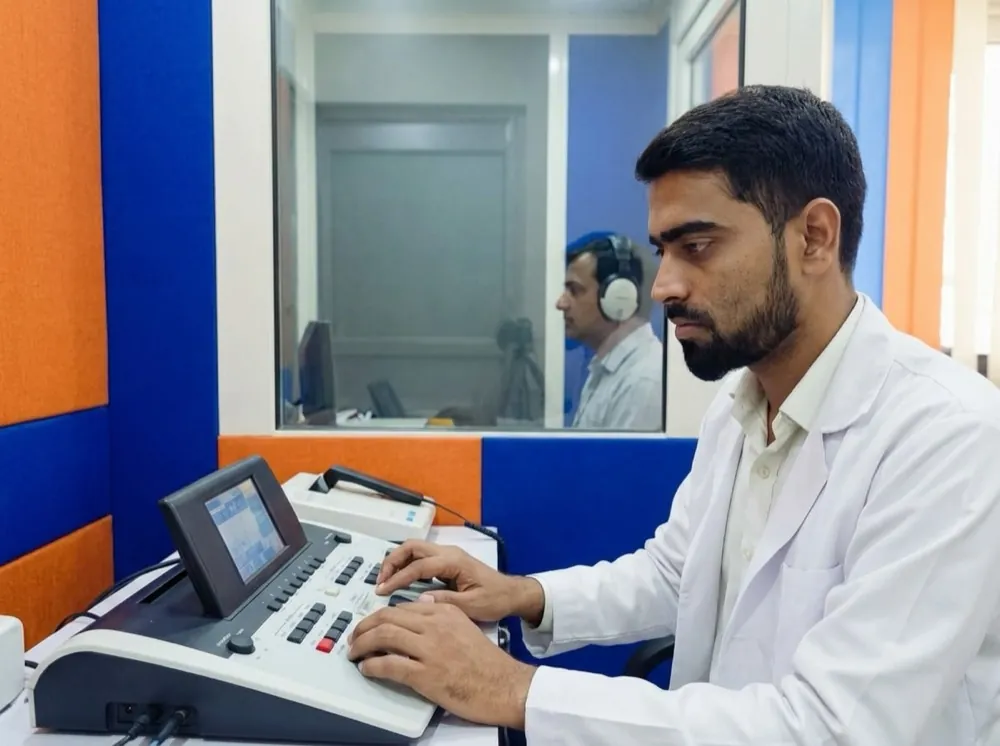
India lives with over ten crore people with diabetes, and Gujarat sits high on that list. Every diabetic knows the annual drill — eye check for the retina, urine test for the kidneys, foot examination for the nerves. Yet almost nobody is told to test the one sense organ that runs on the same delicate small blood vessels and nerves: the ear. At our Gandhinagar clinic, we regularly meet patients whose hearing loss progressed quietly for years while every other complication was being monitored.
Can diabetes cause hearing loss?
Yes — and the link is well documented. The cochlea, your inner-ear hearing organ, is fed by some of the smallest blood vessels in the body and depends on a healthy hearing nerve. Prolonged high blood sugar damages small vessels and nerves everywhere — that is exactly what causes diabetic retinopathy in the eye and neuropathy in the feet. The cochlea is no exception. Studies consistently find hearing loss is roughly twice as common in people with diabetes as in non-diabetics of the same age, and pre-diabetics also show higher rates.
Does high blood pressure affect hearing too?
It does. The inner ear receives its blood through one tiny end-artery with no backup supply — any compromise in circulation hits it hard. Long-standing hypertension stiffens and narrows these vessels, starving the cochlea’s hair cells, which do not regenerate once lost. Many patients with uncontrolled BP also report tinnitus (ringing or pulsing sounds). And when diabetes and high BP occur together — as they so often do in Indian patients — the risk multiplies rather than adds.
Why diabetic hearing loss goes unnoticed for years
This type of hearing loss is gradual and starts in the high frequencies — consonant sounds like s, sh, t and f. So patients insist “I can hear” while family members notice the real signs: the TV volume creeping up, frequent “what? say again?”, difficulty following conversation in noisy places like weddings or the market, and misheard words on phone calls. Because it is painless and slow, it gets blamed on age and ignored — until communication, confidence and even memory begin to suffer. Untreated hearing loss in older adults is now a recognised risk factor for social withdrawal and cognitive decline.
A pattern we see often at our Gandhinagar clinic: someone managing diabetes carefully for ten or more years, with eye and kidney reports neatly filed, who comes in only after the family insists — and the audiogram shows a high-frequency loss that has clearly been building for years. The frustration is always the same: “nobody told me to check this.”
How often should a diabetic get a hearing test in India?
Our recommendation mirrors what you already do for your eyes: a baseline hearing test at diagnosis, then once every year. A pure tone audiometry (PTA) is painless, takes about 20–30 minutes, and gives a same-day report you can file alongside your HbA1c and eye reports. Yearly audiograms placed side by side reveal any downward drift early — when there is still time to act. For elderly or less mobile patients, we also offer a home-visit hearing test in Gandhinagar.
| Annual diabetic check | Organ protected | How often | Typical cost |
|---|---|---|---|
| Retina (fundus) exam | Eyes | Every year | Varies by hospital |
| Urine albumin / creatinine | Kidneys | Every year | Varies by lab |
| Foot & nerve examination | Feet, peripheral nerves | Every year | Often part of review visit |
| Pure tone audiometry (PTA) | Ears, hearing nerve | Baseline, then every year | ₹300–800 at our clinic |
What if my hearing report shows a loss?
Honesty first: sensorineural hearing loss from diabetes or BP usually cannot be reversed by any medicine, drops or home remedy. What an early diagnosis gives you is control — tighter sugar and BP management to slow further damage, protection from additional insults like loud noise and unsupervised ototoxic medicines, and, where the loss already affects daily life, properly fitted digital hearing aids that restore conversation, confidence and safety. Patients who act at the “mild” stage adapt far better than those who wait years.