
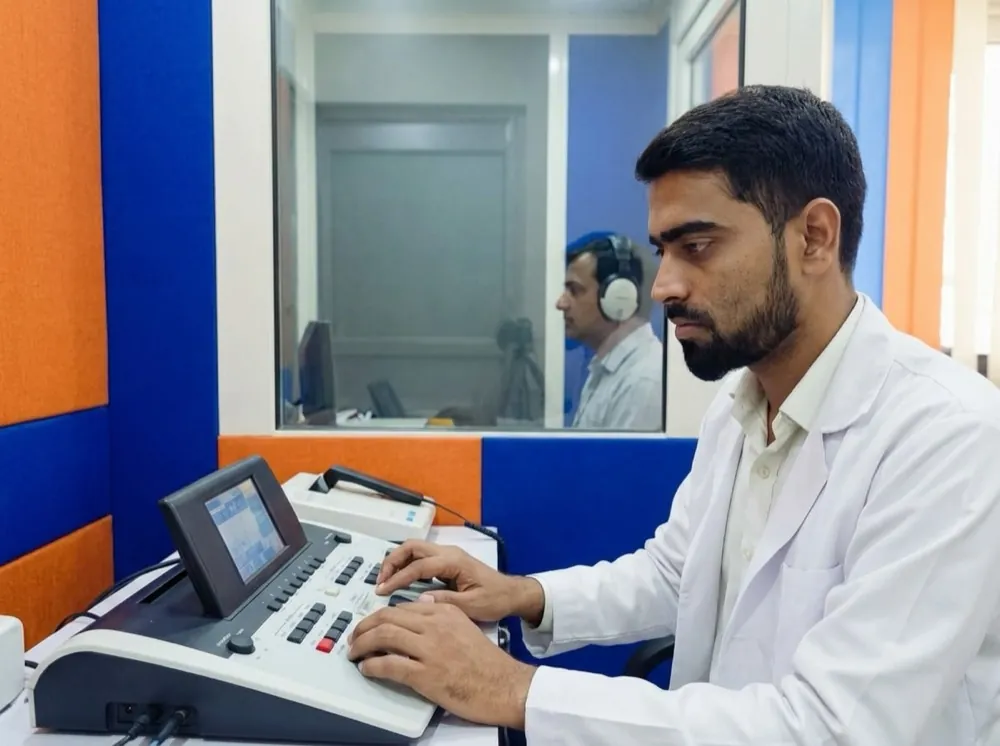
If a doctor has written “PTA” on your prescription, you are about to take the most common hearing test in the world — and one of the easiest. There are no needles, no injections, and nothing enters your ear except a soft headphone cushion. Yet many patients delay the test for months simply because they do not know what happens inside that small soundproof room. This guide walks you through the whole 20-minute experience so you arrive without fear.
What is a PTA test and why did my doctor order it?
Pure Tone Audiometry measures the softest sound you can hear at different pitches — from deep, drum-like tones at 250 Hz to thin, whistle-like tones at 8000 Hz. The results are drawn on a graph called an audiogram, which tells the audiologist not just whether you have hearing loss but how much, at which pitches and in which ear. Doctors order PTA for unclear hearing, ear ringing, fullness in the ear, vertigo workups, before ear surgery, and for school, job or fitness certificates.
What happens step by step inside the booth?
Here is the typical flow of a PTA appointment at our clinic:
| Stage | What happens | Time |
|---|---|---|
| 1. Case history | Questions about your hearing, noise exposure and medicines | 5 min |
| 2. Ear check (otoscopy) | A lighted scope rules out wax or infection | 2 min |
| 3. Air conduction | Headphones on; press the button for every beep you hear | 8–10 min |
| 4. Bone conduction | A small vibrator behind the ear repeats key tones | 5 min |
| 5. Report and counselling | Your audiogram is printed and explained the same day | 5 min |
The booth itself is simply a quiet, sound-treated room. You sit comfortably, the audiologist operates the audiometer just outside, and you can see each other through a window the whole time. If you feel uneasy at any point, raise your hand and the test pauses.
What do the beeps and the button actually mean?
Every beep is a single pure tone played at one fixed pitch and loudness. The audiologist makes each tone softer and softer until you stop responding, then slightly louder until you respond again. That bracketing pins down your threshold — the softest level you can detect at that pitch. Your only job is to press the button (or raise your hand) every time you hear a beep, even if it is very faint or you are only half sure. You cannot “fail by mistake”: each pitch is rechecked several times, so stray guesses cancel out.
After the headphones, a small vibrating band is placed on the bone behind your ear. This bone conduction stage sends sound straight to the inner ear through the skull. Comparing the two sets of results tells us whether the problem sits in the middle ear — often medically treatable — or in the inner ear, which is usually managed with hearing aids.
Does the test hurt or need any preparation?
No pain, no fasting, no preparation. A few small things help: avoid very loud noise (functions, DJ music, long highway rides) the day before, bring any old reports and your list of medicines, and tell the audiologist if you have a cold, ear discharge or recent ear pain. Even ear wax matters — a blocked canal can exaggerate the result, which is why the ear check comes first. We have covered that separately in how ear wax causes temporary hearing loss.
A pattern we see often at our Gandhinagar clinic: a retired teacher or bank employee who postponed the test for two or three years, imagining a long hospital-style procedure, walks out twenty minutes later saying it felt no harder than attending a phone call. The delay is the only costly part — when hearing loss sits untreated, the brain slowly loses practice at decoding speech, and adjusting to help later takes longer.
What happens after the 20 minutes?
You receive your audiogram the same day, explained in plain words rather than jargon. A PTA test costs Rs.300–800 in Gandhinagar, depending on whether extras like speech audiometry or tympanometry are added. If the test finds a loss, you discuss the options calmly — medical referral, monitoring or hearing aids — with no pressure to decide on the spot. People with diabetes or blood pressure should make testing a yearly habit; we explain why in how diabetes and BP quietly affect hearing.
Ready to get tested? Book a hearing test (PTA, audiometry) in Gandhinagar at our Sargasan clinic, or WhatsApp us on 88776 72821 for a same-day slot. We are open Mon–Sat, 9:30 AM to 7:30 PM, and home visits are available for elderly patients.