
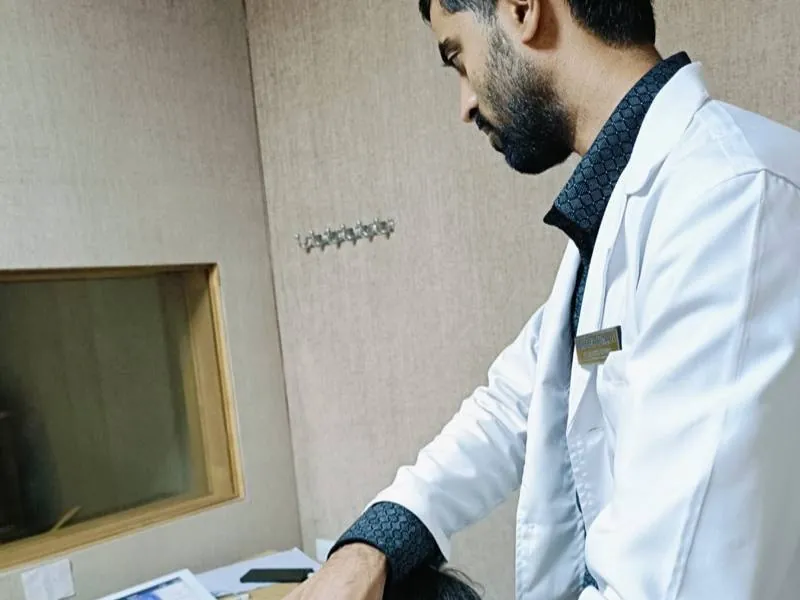
Tympanometry is the quiet workhorse of the hearing clinic. There are no beeps to respond to and no buttons to press — a soft tip rests at the opening of the ear canal, the air pressure changes gently for a few seconds, and a small graph appears. That graph can reveal fluid sitting silently behind a child’s eardrum: the kind that makes a bright child seem inattentive in class. Here is how a two-minute test manages what looking into the ear sometimes cannot.
How does a puff of air test the eardrum?
The eardrum hears best when it can vibrate freely. The tympanometer seals the canal softly, plays a steady low hum, and sweeps the air pressure slightly above and below normal while measuring how much of the hum bounces back. A healthy drum absorbs sound best right at normal pressure; a drum with fluid pressing behind it barely moves at any pressure. The machine plots movement against pressure — that plot is the tympanogram. Because nothing is required from the patient, it works beautifully on infants, restless toddlers and anyone who cannot do a button-press test.
What do Type A, B and C curves mean?
| Curve | Shape | Most likely meaning | Usual next step |
|---|---|---|---|
| Type A | Sharp peak near normal pressure | Eardrum moving freely; middle ear healthy | Nothing further |
| Type B | Flat line, no peak | Fluid behind the eardrum (glue ear); sometimes wax or a perforation | ENT opinion; repeat after treatment |
| Type C | Peak shifted to negative pressure | Eustachian tube blockage after a cold or due to adenoids | Review in a few weeks; often self-corrects |
Two cautions worth knowing. A flat Type B with a large canal-volume reading may mean a perforated eardrum or a grommet rather than fluid. And wax pressed against the probe also flattens the curve — which is why the ear is always inspected first, and why ear wax alone can mimic hearing loss.
Why does tympanometry catch glue ear that other checks miss?
Glue ear (fluid in the middle ear without infection) is sneaky: usually no pain, no fever, no discharge. On otoscopy, thin fluid can leave the eardrum looking almost normal. Young children cannot do a reliable PTA, and even when they can, glue ear’s mild 20–35 dB dip fluctuates — a child can pass on a good day and struggle the rest of the month. The tympanogram does not depend on attention, mood or cooperation: if fluid is there, the curve flattens, full stop. That objectivity is why audiologists run it alongside every child’s hearing assessment.
A pattern we see often at our Gandhinagar clinic: a school-going child whose teacher complains of inattention and whose parents suspect stubbornness, with a history of repeated colds through the winter. The ear looks unremarkable on examination, but tympanometry shows flat Type B curves on both sides. Once the glue ear is treated and hearing returns, the “behaviour problem” dissolves within a term. If speech also sounds behind for age, our guide to the signs a child needs speech therapy is the next read.
Is the test safe for babies and small children?
Yes. The pressure change is tiny — comparable to the fullness you feel in a lift or during an aeroplane’s descent — and it lasts only seconds per ear. The sounds used are at safe, conversational levels, and the test can be repeated as often as needed. Babies are tested in a parent’s lap or during sleep, with a special probe tone used for the youngest infants. The only situations where we hold back are active ear discharge or recent ear surgery, and the examiner checks for both first.
What happens if fluid is found behind the eardrum?
A Type B or C result leads to an ENT opinion, but rarely to panic: most cold-related fluid clears on its own within a few weeks while the nose and allergy side are treated. Fluid that persists beyond about three months with a hearing dip is when options like grommets are discussed, and tympanometry is simply repeated along the way to track progress objectively. The test is normally paired with PTA so you learn both how much hearing is affected and why — book hearing tests (PTA and tympanometry) in Gandhinagar at our Sargasan clinic (a PTA-based assessment runs Rs.300–800), or WhatsApp us on 88776 72821 for a same-day slot.