
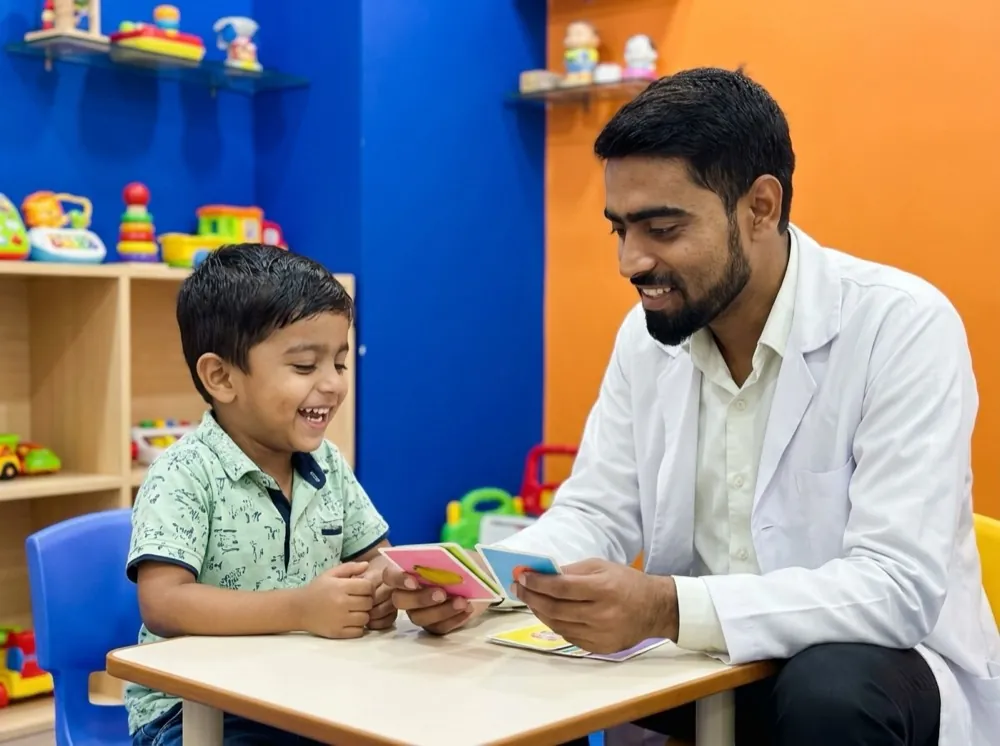
Type “speech therapist near me” in Gandhinagar or Ahmedabad and you will find dozens of options — clinics, home tutors, online apps, even untrained “speech teachers”. Fees vary wildly, and so does quality. As parents, you usually cannot judge therapy technique directly — but you can judge process. These eight questions reliably separate professional speech-language therapy from time-pass sessions.
1. Will you do a full evaluation before starting therapy?
This is the deal-breaker. No serious therapist starts sessions on day one without a structured assessment — of speech sounds, language understanding and expression, oral structures, play and social communication, and a detailed history. Speech delay has many causes, and hearing loss is the most commonly missed one: a child who hears poorly cannot learn to speak clearly. If hearing has never been tested, a hearing test for children in Gandhinagar should come first. A therapist who skips assessment is guessing.
A pattern we see often at our Gandhinagar clinic: a child arrives after a year of “speech classes” elsewhere with no written assessment, no goals and little progress — and our first hearing test reveals a mild loss nobody had checked. The therapy was not necessarily bad; it was simply aimed at the wrong problem.
2. What are your qualifications — and are you RCI-registered?
In India, qualified speech-language pathologists hold a BASLP or MASLP degree and are registered with the Rehabilitation Council of India (RCI). Ask for the registration number; genuine professionals share it without hesitation. (Our clinic operates under Govt. Regd. A101538, and you are welcome to verify credentials before your first visit.)
3. Will my child’s goals be given in writing?
After evaluation, you should receive specific, written goals — for example, “will use 2-word phrases to request in 8 of 10 opportunities” — not vague promises like “speech will improve”. Written goals make progress measurable and keep everyone accountable. If there is nothing in writing, there is nothing to review.
4. Can I sit in the session and learn the home programme?
A child gets perhaps two hours of therapy a week — and over a hundred waking hours with you. Therapists who keep parents permanently outside the room are discarding the child’s biggest resource. Look for someone who welcomes you in, demonstrates techniques, and sends a simple home practice plan. Parent-implemented practice is one of the strongest predictors of faster progress.
5. Which language will therapy be in?
A question Gujarat parents often forget. Therapy works best in the language the child hears at home — Gujarati or Hindi for most families — not automatically in English. Insisting on English-only therapy for a two-year-old from a Gujarati-speaking home slows everything down. Ask whether the therapist can work comfortably in your home language and counsel you on multilingual exposure.
6. How will progress be reviewed, and how often?
Expect a formal review against the written goals every 8–12 weeks — with goals updated, therapy adjusted, or honest conversations if progress has stalled. Be wary of open-ended therapy that drifts for years with no re-assessment and no exit plan.
7. Have you worked with my child’s specific condition?
Speech therapy is broad: late talking, unclear speech, stammering, autism-related communication, hearing-loss and cochlear-implant rehabilitation, voice problems. Ask directly about experience with your child’s profile and what approach they use. A confident professional answers specifically; vagueness is a warning sign.
8. What happens if we miss sessions or live far away?
Consistency beats intensity — long gaps undo gains. Ask how missed sessions are handled and whether structured online speech therapy is available for travel weeks, exam seasons or families outside Gandhinagar. Tele-therapy with parent coaching is well supported by research for many conditions.
| Question to ask | Good sign | Warning sign |
|---|---|---|
| Evaluation before therapy? | Structured assessment, hearing checked first | Sessions start on day one |
| Qualifications? | BASLP/MASLP, RCI number shared openly | Vague “speech teacher” credentials |
| Written goals? | Specific, measurable targets on paper | “Speech will improve” |
| Parent involvement? | You sit in, get a home programme | Parents always kept outside |
| Therapy language? | Child’s home language (Gujarati/Hindi) | English-only by default |
| Progress reviews? | Formal review every 8–12 weeks | Open-ended therapy, no re-assessment |
| Experience with the condition? | Specific answers and approach | Vagueness, one-size-fits-all |
| Missed sessions / distance? | Clear policy, online option offered honestly | No plan for continuity |
One final piece of honesty: no ethical therapist will promise a fixed date by which your child will speak “perfectly”. Children differ, conditions differ, and anyone guaranteeing miracles is selling something. What you should expect is a clear plan, measurable goals and steady, reviewed progress.
Speech therapy for children in Gandhinagar