
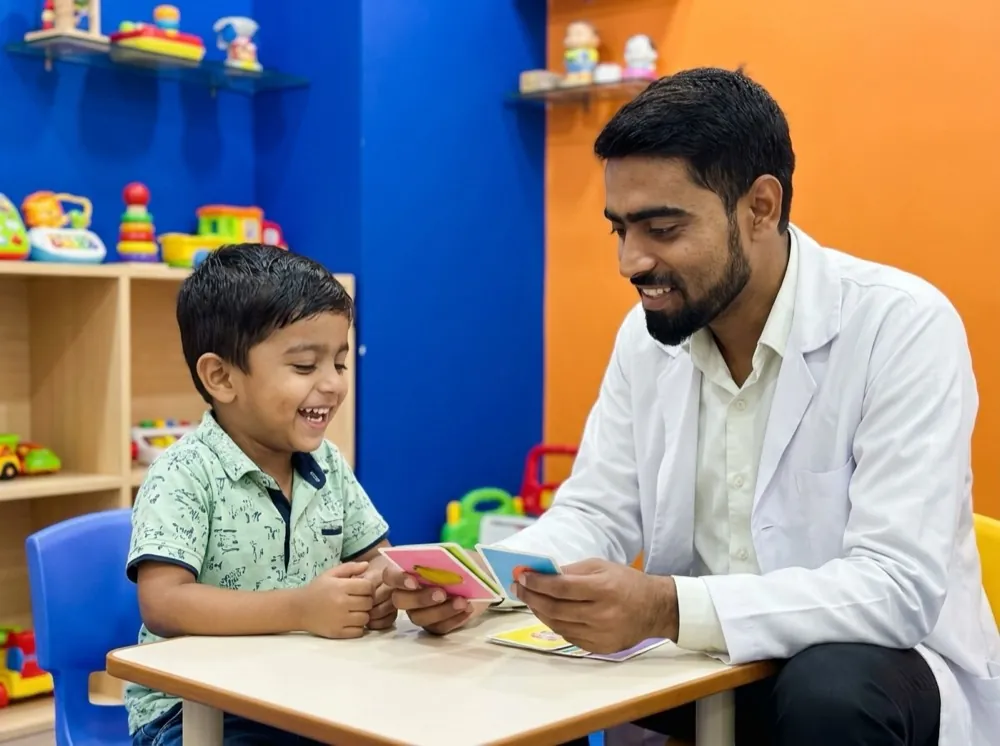
A two-year-old who is not talking yet is one of the most common worries that brings families to our Gandhinagar clinic — usually after months of conflicting advice. “Boys talk late.” “His father also spoke late.” “Stop the mobile and he will speak.” And, increasingly: “Could it be autism?” The honest answer is that late talking has several possible causes, and only a structured evaluation — never a WhatsApp opinion — can tell them apart.
What is a simple speech delay?
A child with an isolated speech-language delay is a communicator who lacks words. They understand much of what is said to them, follow simple instructions, point at things they want, bring toys to show you, wave bye-bye, respond to their name, and make warm eye contact — they simply produce fewer words than expected for their age. Many such children catch up well, especially with timely speech therapy for children in Gandhinagar.
What does autism look like beyond late talking?
In autism spectrum disorder, late talking is only one visible piece. The deeper differences are in social connection and communication intent. Signs parents commonly notice by age two to three include: not responding consistently to their name, limited eye contact, not pointing to share interest (“look, an aeroplane!”), little pretend play, preferring to play alone in repetitive ways, lining up toys, hand-flapping or spinning, strong distress at small changes in routine, and unusual reactions to sounds or textures. Some autistic children speak on time but use language unusually — repeating dialogues or phrases (echolalia) rather than conversing.
Speech delay vs autism: the key difference in one line
A child with a speech delay wants to communicate and finds ways to do it without words — gestures, pointing, pulling your hand, expressions. A child with autism typically shows reduced communication intent itself, along with social and behavioural differences that exist independent of vocabulary.
| What to watch | Simple speech delay | Autism spectrum |
|---|---|---|
| Response to name | Usually consistent | Often inconsistent |
| Eye contact | Warm and natural | Often limited or fleeting |
| Pointing & gestures | Used freely to communicate | Reduced — especially pointing to share interest |
| Pretend play | Develops normally | Limited; play may be repetitive (lining up toys) |
| Understanding language | Often better than speaking | Variable; may not follow simple instructions |
(Typical patterns, not a diagnosis — overlap is common, which is why a structured evaluation matters.)
Where the two overlap — and why parents get confused
Overlap is real: many autistic children also have a language delay, some late talkers go through a phase of tantrums simply from frustration at not being understood, and screen-heavy routines can make any toddler look withdrawn. There is also a third possibility everyone forgets — hearing loss — which can mimic both conditions almost perfectly: a child who cannot hear well will not respond to their name, will not develop words, and may seem “in their own world”.
Why a hearing test must come first
This is the firm rule in our clinic: every late-talking child gets a hearing evaluation before any other label is discussed. Even a mild or one-sided loss — often from something as treatable as middle-ear fluid — can derail speech development. For toddlers who cannot do button-press tests, objective tests like OAE and the BERA / ASSR test for toddlers measure hearing accurately without the child’s cooperation, even during natural sleep. Skipping this step has cost many families a year of therapy aimed at the wrong problem.
A pattern we see often at our Gandhinagar clinic: a late-talking toddler arrives already carrying an informal “autism” label from relatives or online checklists — and the hearing evaluation reveals middle-ear fluid quietly muffling everything the child hears. Once the hearing is managed and therapy begins, the picture often looks very different.
What does a full evaluation check?
After hearing is confirmed, a speech-language pathologist assesses: how much the child understands (receptive language) versus expresses; gestures, pointing, and joint attention; play skills and imitation; social response and eye contact; oral-motor function; and a detailed history of milestones, birth events, and family patterns. Standardised tools and structured observation — not a five-minute glance — separate an isolated delay from autism, from hearing loss, or from a combination.
Whatever the cause: do not “wait and watch”
The brain learns language fastest before age five. Whether your child needs simple language stimulation, autism-focused speech therapy, or hearing management, starting early multiplies the result. Waiting for a child to “grow out of it” is the only option with no upside.
Frequently asked questions
Does late talking always mean autism?
No. Most late talkers are not autistic — causes range from simple developmental delay to hearing loss to bilingual adjustment. But because early autism support changes outcomes dramatically, a proper evaluation is worth doing rather than guessing.
Can a child have both speech delay and autism?
Yes, the two frequently co-exist — many children on the spectrum also have a significant language delay. A combined assessment plans therapy for both the language gap and the social-communication differences together.
At what age should I get my child evaluated?
Trust your instinct over the calendar — but as a guide: no babbling by 12 months, no single words by 18 months, no two-word phrases by 2.5 years, poor response to name at any age, or any loss of previously learned words deserves evaluation immediately.