
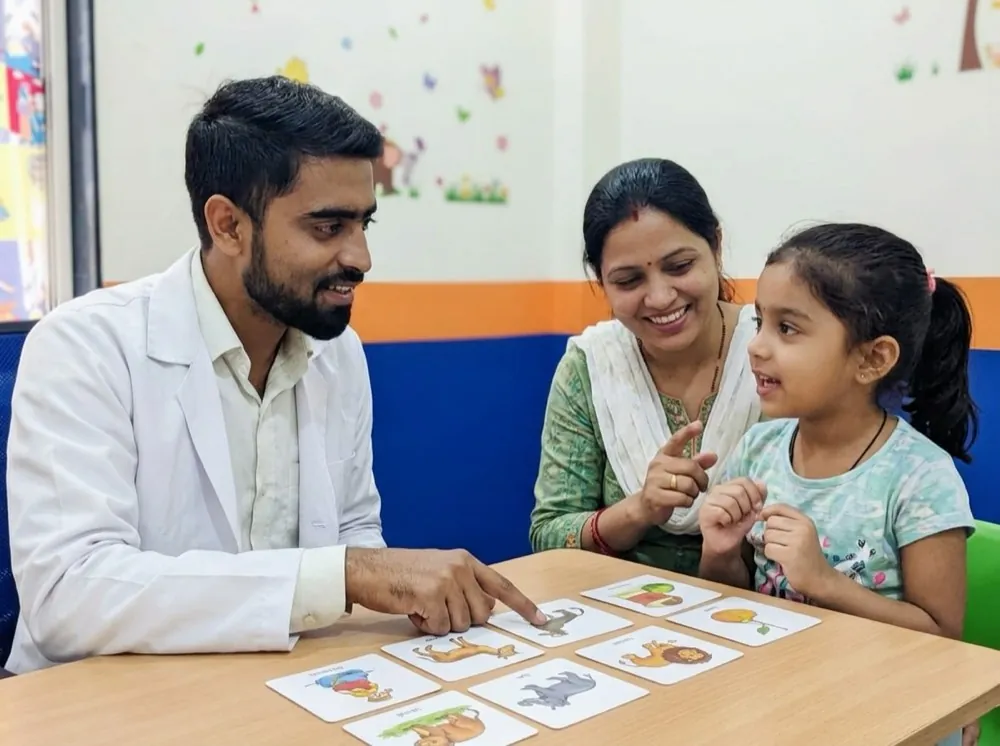
Parents often arrive at our clinic asking for “exercises” — something like physiotherapy for the mouth. The truth is simpler and harder: for a late-talking toddler, the most powerful exercise is changing how the family talks at home, every day, in ordinary moments. Here are fifteen activities we actually teach parents, grouped so you can start today.
Why do home activities matter so much?
A child attends therapy for one or two hours a week — and is awake at home for around eighty. Whatever target the therapist sets, it is the hundreds of small repetitions at home that wire it in. That is why we treat parents as co-therapists, and why these activities are designed around things every Gujarati household already has: a kitchen, routines, and people who love the child.
How should you talk so your child learns? (Activities 1–5)
These five techniques are the engine behind everything else. They look deceptively simple; done consistently, they change the language environment completely.
| Technique | What you do | Example |
|---|---|---|
| 1. Self-talk | Narrate your own actions in short sentences | “Mumma is cutting. Cutting tamatar. Red tamatar!” |
| 2. Parallel talk | Narrate what your child is doing | “You're pushing the car. Car goes fast!” |
| 3. Choice-giving | Offer two options instead of yes/no questions | “Doodh or paani?” — and wait |
| 4. Wait time | Pause 5–10 seconds expectantly after asking or offering | Hold the biscuit, look at the child, count silently to ten |
| 5. Expansion | Repeat the child's word and add one more | Child: “ball” — You: “Big ball! Throw ball!” |
One rule cuts across all five: talk at your child's level plus one word. If your child speaks single words, model two-word phrases — not full paragraphs.
Which kitchen games build speech? (Activities 6–10)
- 6. Dal-chawal sorting. Sort rajma and chana into katoris while naming each one — “in”, “more”, “all gone” are perfect early words.
- 7. Rotli dough play. Press, roll, poke. Model action words: “press!”, “roll roll roll”, “big rotli, small rotli”.
- 8. Steel dabba band. Drum on dabbas and say “dham dham”, “ting ting”. Sound imitation comes before word imitation — this is a real therapy step, not just noise.
- 9. Snack in a tight jar. Put chakri or murmura in a transparent jar your child cannot open. They must come to you — wait for a sound, gesture or word like “open” before helping.
- 10. Pretend chai. Pour, stir, sip, offer to teddy. Pretend play and language grow on the same branch of development; “hot!”, “more chai”, “papa's cup” all live here.
Which play routines pull words out? (Activities 11–15)
- 11. Bubbles with a pause. Blow once, screw the lid back, wait. The child must request — any sound counts at first, then “more”, then “more bubble”.
- 12. Ready… steady… go! Cars, swings, tickles — say “ready, steady…” and wait for your child to attempt “go!” before the fun happens.
- 13. Picture book pointing. Not reading — pointing and naming together. Follow your child's finger and name that, instead of quizzing “what is this?”
- 14. Action songs with gaps. Sing a familiar rhyme and stop before the last word — “machli jal ki…” — and let your child fill the gap.
- 15. The wrong-thing game. Hand over a spoon when they asked for the ball, with a twinkle in your eye. Gentle absurdity provokes protest — and protest is communication.
A pattern we see often at our Gandhinagar clinic: two children start therapy the same month with similar delays. In one family, parents run these routines daily; in the other, practice happens only in the clinic. Within three months the gap between the two children is unmistakable — same therapist, same plan, different homes.
What mistakes should you avoid?
Three habits quietly undo all of the above: quizzing (“say mumma! say it!” — pressure shuts late talkers down), anticipating every need (a child whose water appears before they ask never needs words), and screens during practice hours — a rhyme video talks at your child but never waits for an answer. If you suspect a real delay, check our guide to the signs a child needs speech therapy, and if your toddler understands well but says little, read why a 2-year-old may understand everything but not talk.
And remember the honest caveat in our quick answer: these activities multiply therapy, they do not replace it. If travelling to Sargasan is hard, our online speech therapy sessions bring the therapist into your living room — sessions typically cost Rs. 500–1,000 and include exactly this kind of parent coaching.
WhatsApp us for a home-practice plan