
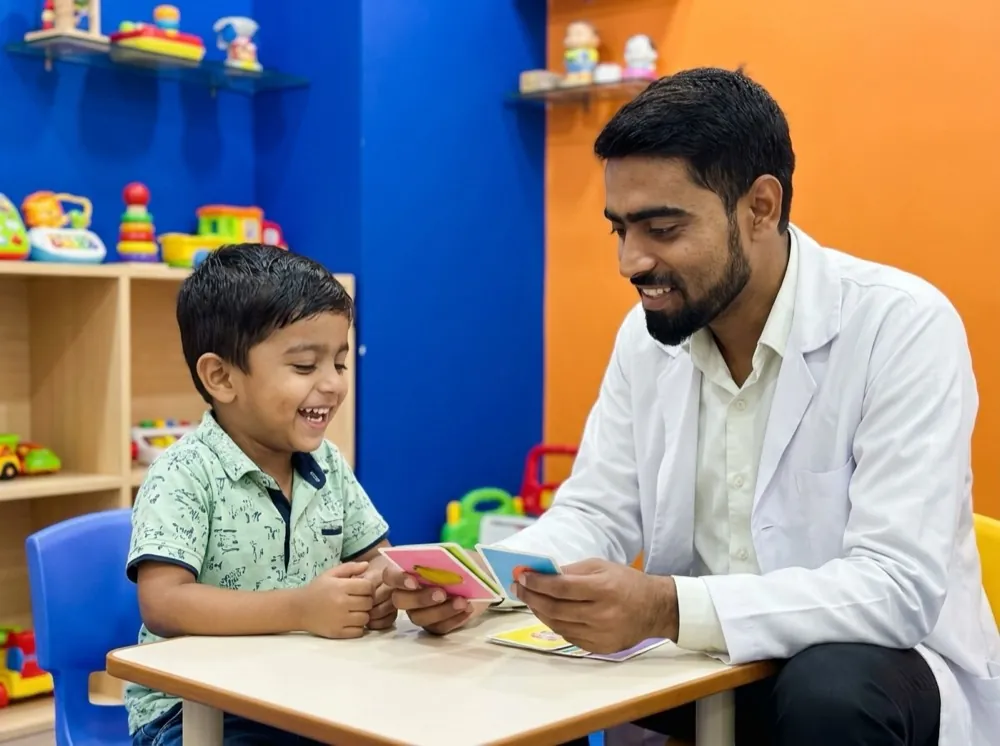
If you have typed “2 year old not talking but understands everything” into Google at midnight, you are in the largest club of worried parents on the internet — and in our waiting room. The understanding part genuinely matters: it is a strength. But it is not, by itself, an all-clear. Here is how professionals actually think about this situation.
Is my 2-year-old a late talker or speech delayed?
A late talker is a child whose understanding, play, gestures and social connection are all on track — only spoken words are behind. Many late talkers catch up by themselves. A speech-language delay means something more is going on: comprehension is weaker than it appears, hearing is reduced, or social communication is different. The frustrating truth is that at age 2 these can look identical to the family — especially because parents naturally read context. When you say “chappal lav” while looking at the chappal and holding out your hand, a child can obey perfectly using your gestures alone. That is why “he understands everything” needs testing, not assuming.
How many words should a 2-year-old say?
| Age | Typical talking milestones | Discuss with a professional if… |
|---|---|---|
| 12 months | Babbling with variety; first word; responds to name | No babbling, no response to name or sounds |
| 18 months | 10–20 words; points to show and to ask | No words, no pointing |
| 24 months | About 50+ words; two-word combinations (“mumma paani”) | Fewer than 50 words or no combinations |
| 30 months | Vocabulary growing weekly; short phrases; strangers follow some speech | Word count stuck; no phrases; words once used now lost |
Count any consistent word in any language — Gujarati, Hindi, English, even a consistent “baba” for bottle. Word approximations count; rhymes memorised from videos do not, because they are not used to communicate.
Why are “boys talk late” and “his father also spoke late” risky assumptions?
Both contain a grain of truth, which is exactly what makes them dangerous. Boys do average slightly later than girls — by weeks, not by a year; being a boy never explains a 2-year-old with five words. And a family history of late talking genuinely does raise the chance your child is a harmless late bloomer — but studies following late talkers show family history also appears in children whose delays persist. Nobody in 1995 assessed whether papa was a true late bloomer or a child who quietly struggled through school. The cost-benefit is lopsided: if you act and the child was fine, you have lost one consultation fee; if you wait and the child was not fine, you have lost a year of the brain's best language-learning window.
A pattern we see often at our Gandhinagar clinic: a family arrives when the child is past 3, saying “everyone told us his father also spoke late, so we waited.” The child now needs therapy anyway — but starts it a full year later, with frustration, tantrums and preschool struggles already in the picture. The families who came at 2 with the same story almost always have the easier road, whichever way the assessment went.
What does a 30-minute assessment actually rule out?
This is the part most parents do not realise: a first assessment is mostly about ruling things out, and it is quick. In one sitting we check hearing (even mild loss from middle-ear fluid silently delays speech — testing costs around Rs. 300–800), true comprehension without gesture clues (“put the spoon in the cup” with neutral hands tells us far more than home routines can), communication drive (pointing, showing, eye contact — the markers that separate simple delay from broader conditions), and oral-motor function. If everything except expression is strong, you leave with a home-stimulation plan and a review date — not necessarily therapy. If something needs work, you have caught it at the best possible age. Our post on speech delay vs autism explains the social-communication markers in detail.
What can you start doing at home today?
Whatever you decide about assessment, three changes help immediately: cut passive screen time hard (our guide on screen time and speech delay has a realistic step-down plan), create reasons to communicate by pausing instead of anticipating every need, and narrate daily life in short, simple sentences in your strongest language. And if the word count at 24 months is below 50, book a child speech therapy assessment in Gandhinagar — thirty minutes replaces a year of midnight googling.
WhatsApp us about your 2-year-old