
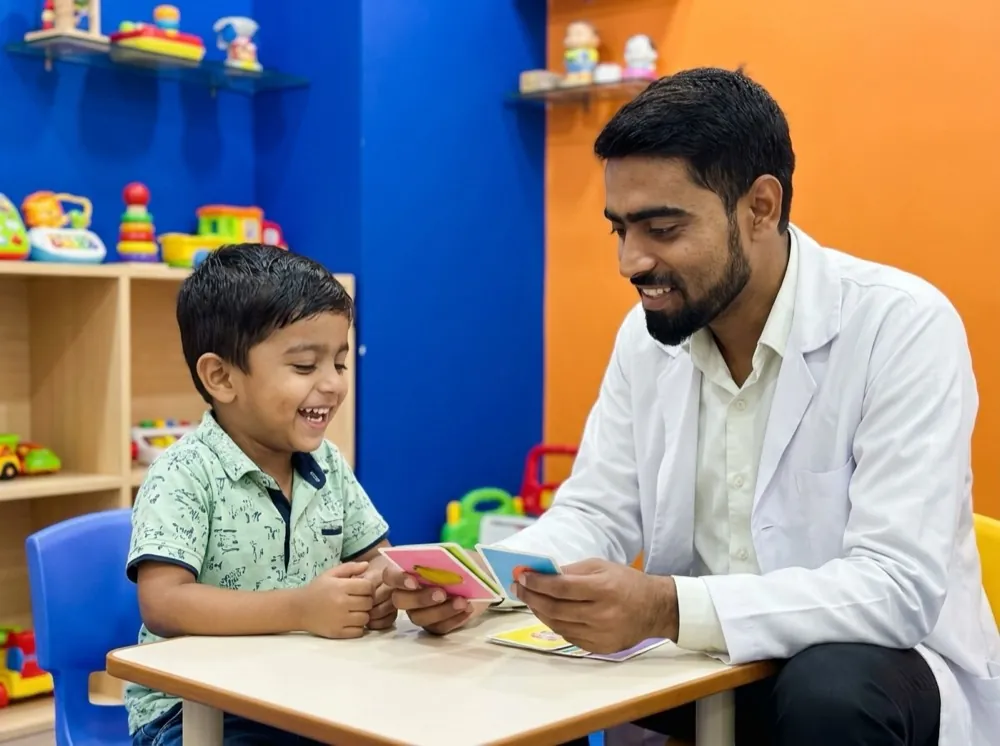
It is the most common confession we hear from parents in our consultation room: “He only eats if we play YouTube. We know it is wrong, but otherwise he won't take a single bite.” If that is your house too, this article is not here to make you feel guilty. It is here to explain what screen time actually does to speech development — and what a realistic exit looks like.
Does screen time actually cause speech delay?
The honest answer: screens are strongly associated with delayed speech, and the mechanism is well understood — but it is not the glowing rectangle itself that does the harm. Children learn language from serve-and-return interaction: the child babbles or points, an adult responds, the child responds back. Large studies have found that more handheld screen time in toddlers goes hand in hand with later expressive language, and that the number of conversational turns at home is one of the strongest predictors of vocabulary. A screen takes thousands of those turns out of the day and gives nothing back. The video talks at your child; it never waits for your child to answer.
What do WHO and IAP recommend by age?
Both the World Health Organization and the Indian Academy of Pediatrics have published clear age-wise guidance:
| Age | WHO / IAP recommendation | What that means at home |
|---|---|---|
| 0–2 years | No screen time at all (video calls with family excepted) | No mobile during meals; rhymes sung by you, not by YouTube |
| 2–5 years | Maximum 1 hour per day, less is better, always supervised | One fixed slot, sit together, talk about what you watch |
| 5 years and above | Balanced with sleep, play and study; screens out of the bedroom | Family media rules; no screens an hour before bed |
Notice the exception: live video calls are not counted as harmful screen time, because a grandparent who responds to the child is interaction, not passive viewing.
Why doesn't a talking cartoon teach talking?
Parents reasonably ask: the cartoon speaks, my child listens — is that not exposure? Unfortunately, research on what is called the video deficit shows toddlers learn far less language from a screen than from the same words spoken by a live person. A video cannot follow your child's gaze, cannot name the thing your child is pointing at this second, and cannot pause when your child tries to say something. Many toddlers we see can recite “Baby Shark” perfectly yet cannot say paani when thirsty — memorised sound, not usable language.
A pattern we see often at our Gandhinagar clinic: a bright two-and-a-half-year-old who watches three to four hours of rhymes daily, speaks fewer than ten words, and the family is convinced the videos are “teaching English”. When screens are cut and the same hours are filled with talk and play — usually alongside a few therapy sessions — words frequently start appearing within weeks. The child was never unable to learn; the input was simply the wrong kind.
The phone is the only way my child eats — how do we step down?
Going cold turkey on day one usually ends in a screaming match and a defeated parent reaching for the phone again. A gradual step-down works better:
- Week 1 — separate screen from food. Keep the video, but move it to after the meal as a short reward. The habit to break first is “screen = eating”, not screen itself.
- Week 2 — shrink and fix the slot. One or two fixed slots of 15–20 minutes, with a visible timer. The timer becomes the villain, not you.
- Week 3 — replace, don't just remove. A child who loses the screen and gets nothing will fight for it. Offer something with hands and attention: dal to sort, dough to press, a steel dabba band, bubbles on the balcony.
- Week 4 onwards — protect the gains. No screens during meals, in the car for short trips, or in the hour before sleep. Keep your own phone away during play time — children copy what they see.
Expect two or three rough days at each step. They pass faster than most parents fear, especially when both parents and grandparents follow the same rule.
When should screen worries become a speech assessment?
Cutting screens is the right first move, but it is not a treatment plan. Get a professional evaluation if your child has fewer than 50 words or no two-word phrases by age 2, does not respond consistently to name, or you simply feel speech is behind other children of the same age. A structured child speech therapy assessment in Gandhinagar checks hearing, understanding and expression together — because a child who cannot hear clearly cannot learn to speak clearly, whatever the screen habits. You may also find our guides on the signs a child needs speech therapy and the difference between speech delay and autism useful before your visit.
WhatsApp us about your child's speech