
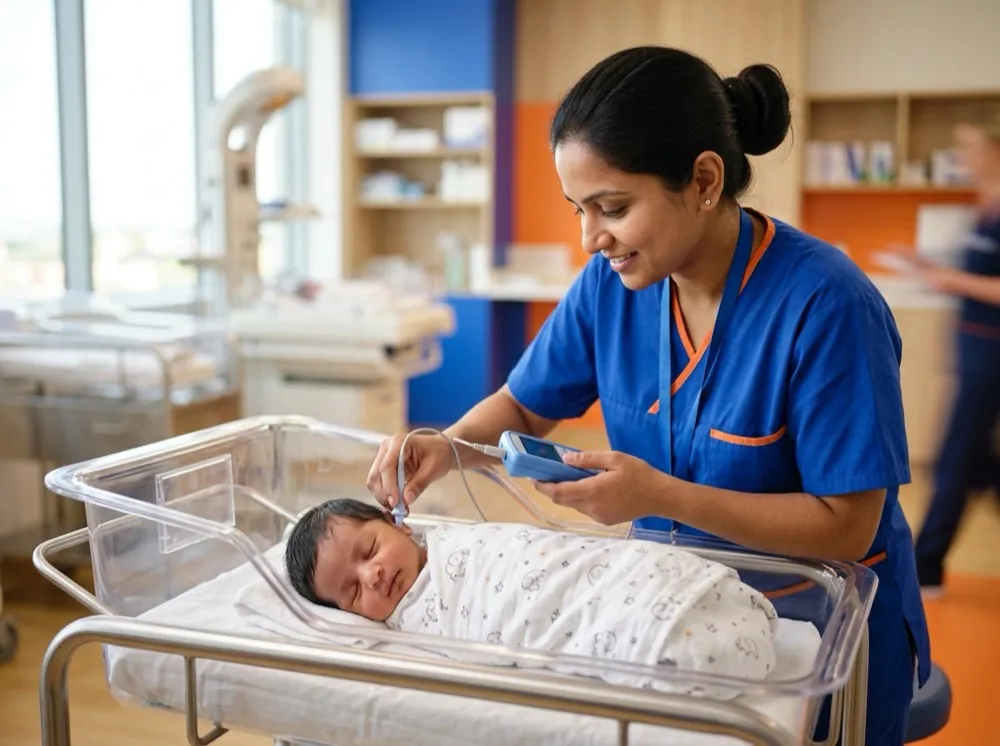
When an implant team tells parents “do not delay”, it can sound like sales pressure. It is not. The urgency comes from one of the best-established findings in hearing science: the younger the brain receives sound, the more completely it learns to use it. This article explains that finding in plain language — and then answers, honestly, the question families of older children and adults are quietly carrying: have we missed the bus?
What is brain plasticity, in parent language?
Think of the hearing parts of a baby’s brain as wet cement. In the first two to three years, every sound that arrives leaves a deep, permanent impression — this is why toddlers absorb Gujarati, Hindi and a few English words simultaneously without a single grammar lesson. Around age three the cement begins to set; learning is still possible, but each impression takes more effort and goes less deep. If no sound arrives at all during those years, the brain does not keep the space reserved — it gradually reassigns listening areas to vision and other senses. An implant given early pours sound into wet cement. The same implant given late pours it onto a surface that has already begun to harden.
Why is “before age 2” the practical target?
Most Indian implant programmes operate from around 9–12 months of age, once anaesthesia is comfortably safe and testing (BERA, ASSR and a properly documented hearing aid trial) is complete. Implanted in this window, a child’s “listening age” starts only months behind their birth age, and with consistent auditory verbal therapy many enter mainstream school alongside hearing classmates. That is also why newborn screening matters so much: a baby flagged at birth through the OAE newborn screening test and confirmed with a BERA test can complete the entire pathway — diagnosis, hearing aid trial, candidacy, surgery — before the second birthday.
What can families realistically expect at each age?
| Age at implantation | Realistic expectation with consistent therapy |
|---|---|
| 9–18 months | Best-case window — spoken language often approaching age-appropriate levels by school entry |
| 18 months–3 years | Very good outcomes common; the language gap is real but usually closable with intensive AVT |
| 3–6 years | Useful speech achievable, especially with prior hearing-aid use; progress is slower and therapy heavier |
| School age and teens | Outcomes vary widely — strongest in children who already use hearing aids and some spoken language |
| Adults (hearing lost after learning speech) | Often excellent for conversation and phone use, even decades after losing hearing |
These are honest patterns, not promises — outcomes also ride on therapy consistency, family involvement and the child’s overall development. The table’s real message is the slope: every band down costs something that effort must repay.
Is it too late for an older child or an adult?
Two very different questions hide here. An adult who once heard normally — who spoke on the phone, attended meetings, and then lost hearing to age, infection or medication — carries a fully built language brain. For them, an implant reconnects an existing network, and results are frequently life-changing regardless of age; seventy is not too old. An older child deaf since birth who has never heard speech is the harder conversation: the implant will deliver sound, but a brain that has spent ten years without auditory input rarely converts it into fluent spoken language. Good teams do not refuse such families — they counsel them honestly about goals, from environmental sound awareness to support for lip-reading, so the decision is informed rather than hopeful.
A pattern we see often at our Gandhinagar clinic: a baby is flagged in newborn screening, but the family decides to wait “until he is a little older and stronger” — and arrives for help past the third birthday. Surgery is still very much possible, and we never shame a family for the delay; but the therapy road is now measured in years instead of months. The kindest thing this article can do is reach the next family earlier: testing is painless, and acting at ten months is easier than catching up at four years. Our team coordinates the whole journey — confirmation testing, hearing aid trial, candidacy work-up and post-surgery cochlear implant rehabilitation in Gandhinagar — so no month is lost to confusion.
Get your child’s pathway planned