
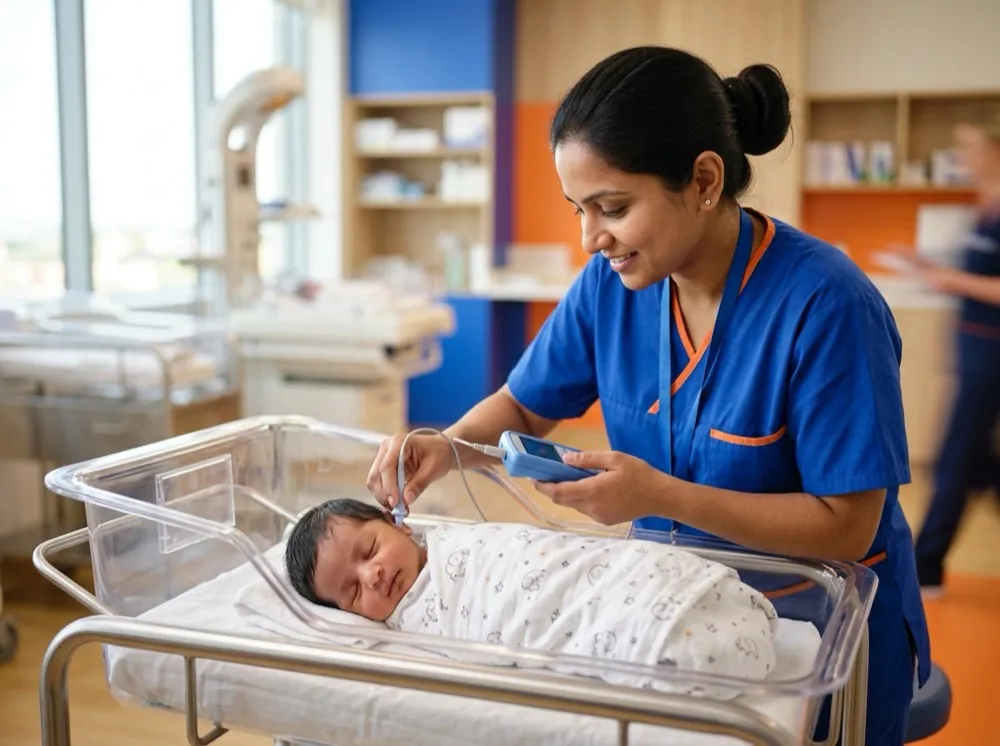
In the first days of life a newborn cannot tell us what she hears — but her inner ear can. The OAE (otoacoustic emissions) test listens for a tiny echo that a healthy cochlea produces, and it does so in about five minutes while the baby sleeps in the mother’s lap. Here is what actually happens during the screen, what the word “refer” on the report really means, and the timeline every new parent in Gujarat should know by heart.
What exactly happens during an OAE test?
A soft rubber tip, smaller than an earphone bud, rests at the opening of the baby’s ear canal. It plays gentle clicking sounds, and a sensitive microphone inside the same tip records the cochlea’s response — a faint echo generated by the outer hair cells of a healthy inner ear. The machine then shows a simple result for each ear: pass or refer. There are no needles, no sedation and no discomfort; most babies sleep straight through it, and the whole visit, both ears included, rarely crosses ten minutes.
Why must it be done before one month?
Hearing is the doorway to speech. A baby’s brain starts wiring itself for the sounds of Gujarati, Hindi or English from the very first weeks, so the earlier a hearing problem is found, the less language time is lost. There is a practical reason too: newborns sleep deeply and stay still, which makes the test quick and clean, while older infants wriggle and protest. Many maternity hospitals in Gujarat now screen before discharge; if yours did not, simply book the OAE in the first two to four weeks — it is never an emergency, but it should never be forgotten either.
The report says “refer” — does my baby have hearing loss?
Take a breath: refer is not a diagnosis. It only means the echo was not recorded clearly on that day, and very ordinary things cause that — vernix (the white birth coating) in the ear canal, fluid left over from delivery, a noisy room or a restless baby. Many babies who refer in the first day or two pass comfortably on a repeat screen after two to three weeks. What a refer result does demand is follow-up; the only wrong response is to ignore it.
A pattern we see often at our Gandhinagar clinic: parents arrive frightened, having read “refer” on the maternity hospital report as “deaf”. On repeat OAE a few weeks later, once canal fluid has cleared, many of these babies pass — and for those who do not, a BERA test (our parents’ guide explains it) settles the question definitively. Either way the family ends up ahead, because they acted instead of waiting.
What is the 1-3-6 rule every parent should know?
| Deadline | Milestone | Test or action |
|---|---|---|
| By 1 month | Hearing screening completed | OAE |
| By 3 months | Diagnosis confirmed if the screen referred | BERA / ASSR (Rs.1,500–3,500) |
| By 6 months | Intervention started if loss is confirmed | Hearing aids and family-guided therapy |
This international timeline exists because children identified and supported by six months of age have the best chance of developing speech on schedule with their hearing peers. Every month of delay after that makes the catch-up climb steeper — which is why the humble five-minute OAE sits at the head of the whole chain.
What if hearing loss is confirmed?
It is the start of a plan, not the end of one. BERA grades the degree of loss, hearing aids can be fitted within the first six months of life, and parents are coached to flood the baby with language at home. For severe losses, cochlear implant evaluation begins early. And for every child — including those who passed at birth — keep watching milestones; our guide to the signs a child needs speech therapy lists what to expect at each age.
If your baby has not been screened yet, book a newborn hearing screening (OAE test) in Gandhinagar at our Sargasan clinic, or WhatsApp us on 88776 72821. The screen takes five minutes and the result is in your hands before you leave.