
“Sir, can my hearing come back?” is the first question almost every patient asks at our Gandhinagar clinic. And the honest answer is always the same: it depends on the type. Hearing loss is not one disease. Depending on where the problem sits inside the ear, the same complaint — “I can’t hear properly” — can mean something a course of medicine will fix, something a small surgery will fix, or something only a hearing aid can manage. This guide explains the three types in plain language, so that after your diagnosis you know exactly what to ask.
What are the three types of hearing loss?
Sound travels through three zones: the outer ear (canal and eardrum), the middle ear (three tiny bones that pass vibrations along), and the inner ear (the cochlea, where vibrations become nerve signals for the brain). Hearing loss is classified by which zone fails:
- Conductive hearing loss — sound is physically blocked or weakened in the outer or middle ear before it ever reaches the nerve.
- Sensorineural hearing loss — the inner ear or hearing nerve itself is damaged, so the signal never forms properly.
- Mixed hearing loss — both problems exist in the same ear at the same time.
What is conductive hearing loss — and why is it often curable?
Think of conductive loss as a volume problem, not a clarity problem. The inner ear is healthy; sound just is not reaching it at full strength. Common causes we see every week: impacted ear wax, fluid behind the eardrum after a cold, middle-ear infection (very common in children), a perforated eardrum, and otosclerosis — a stiffening of the middle-ear bones. Because these are mechanical problems, many of them are treatable or fully curable: wax can be removed in minutes, infections respond to medicine, perforations and bone stiffness can often be repaired surgically by an ENT surgeon. This is exactly why you should never buy a hearing aid for an undiagnosed loss — you might be amplifying your way around a problem a doctor could simply fix.
What is sensorineural hearing loss?
Sensorineural loss is a clarity problem. The microscopic hair cells of the cochlea, or the nerve behind it, are damaged — by ageing (presbycusis), years of loud noise, diabetes and blood-pressure disease, certain medicines, or sometimes a sudden viral or vascular event. Patients describe it perfectly without knowing the term: “I hear the sound, but I can’t catch the words.” Damaged hair cells do not grow back, so medicine and surgery cannot reverse the typical age-related or noise-related loss. The good news is that modern digital hearing aids, programmed to your exact audiogram, manage sensorineural loss extremely well — and the earlier they are fitted, the easier the brain adapts. If you have diabetes or hypertension, it is worth reading how diabetes and blood pressure quietly damage hearing, because annual testing catches this type early.
One critical exception: sudden sensorineural hearing loss — hearing that drops over hours or a couple of days, often in one ear — is a medical emergency where early steroid treatment can sometimes restore hearing. That deserves a same-week visit, not a wait-and-watch approach.
What is mixed hearing loss?
Mixed loss means both problems in one ear — for example, an elderly person with age-related nerve loss who also has impacted wax or a chronically discharging ear. Treatment happens in two steps: the conductive part is treated medically or surgically first, and whatever sensorineural loss remains is then managed with a hearing aid. Skipping the first step is a common and costly mistake; the conductive component can often be improved, making the eventual hearing aid fitting simpler and cheaper.
How does an audiologist find which type you have?
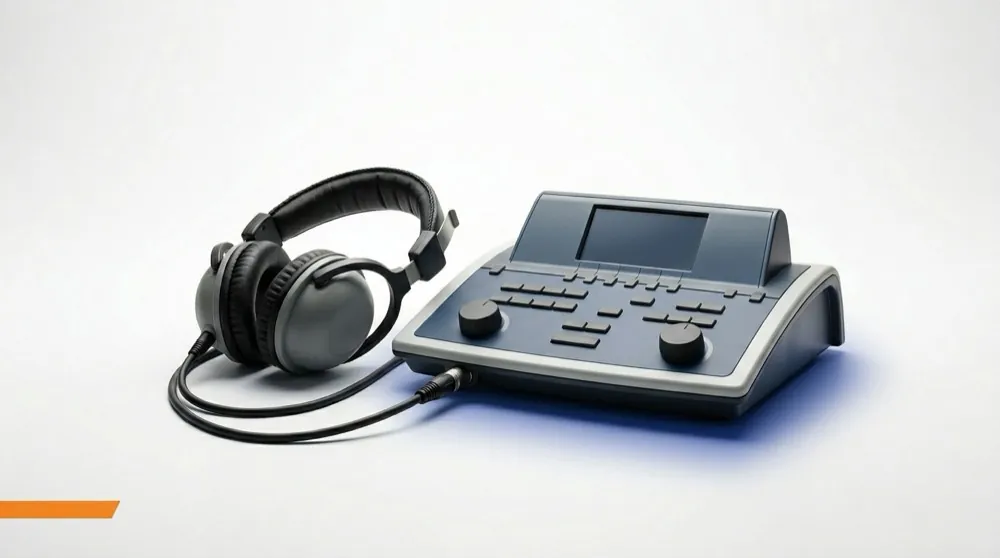
This is the part patients find almost magical, and it is beautifully simple. Pure tone audiometry (PTA) measures your hearing two ways: through headphones (air conduction — testing the whole pathway) and through a small vibrator placed on the bone behind your ear (bone conduction — sending sound directly to the inner ear, bypassing any blockage). Comparing the two tells the story: if bone conduction is normal but air conduction is poor, the inner ear is fine and the problem is conductive. If both are equally reduced, the loss is sensorineural. If both are reduced but air is worse, it is mixed. A hearing test (PTA, audiometry) in Gandhinagar takes about 30 minutes, costs roughly Rs.300–800, and you walk out with the answer the same day.
| Conductive | Sensorineural | Mixed | |
|---|---|---|---|
| Where the problem sits | Outer or middle ear | Inner ear / hearing nerve | Both |
| Common causes | Wax, ear infection, fluid, perforated eardrum, otosclerosis | Ageing, noise exposure, diabetes/BP, some medicines | Nerve loss plus wax, infection or perforation |
| How it sounds | Soft but clear — like ears blocked after a flight | Loud enough but unclear — words get jumbled | Soft and unclear |
| First treatment | Medicine or surgery — often curable | Hearing aids; sudden loss needs urgent steroids | Treat conductive part first, then hearing aid |
A pattern we see often at our Gandhinagar clinic: a middle-aged patient arrives ready to spend on hearing aids because a family member uses them, and the audiogram shows a purely conductive loss from long-standing wax or middle-ear fluid. After proper treatment their hearing returns to near normal — no hearing aid needed at all. The reverse also happens: years of “it’s just wax” assumptions hiding a progressing sensorineural loss. Either way, the test settles it; for an everyday example of the first pattern, see how ear wax causes temporary hearing loss.
What should you ask after your diagnosis?
Take your audiogram and ask three questions: (1) Is my loss conductive, sensorineural or mixed? (2) Is any part of it medically treatable before we discuss devices? (3) If hearing aids are the answer, what degree of loss am I fitting for? Those three questions protect you from both extremes — buying an unnecessary device, and delaying a necessary one. If you would like your report explained in plain Gujarati, Hindi or English, message us on WhatsApp at 88776 72821 — bring any old reports along too.