
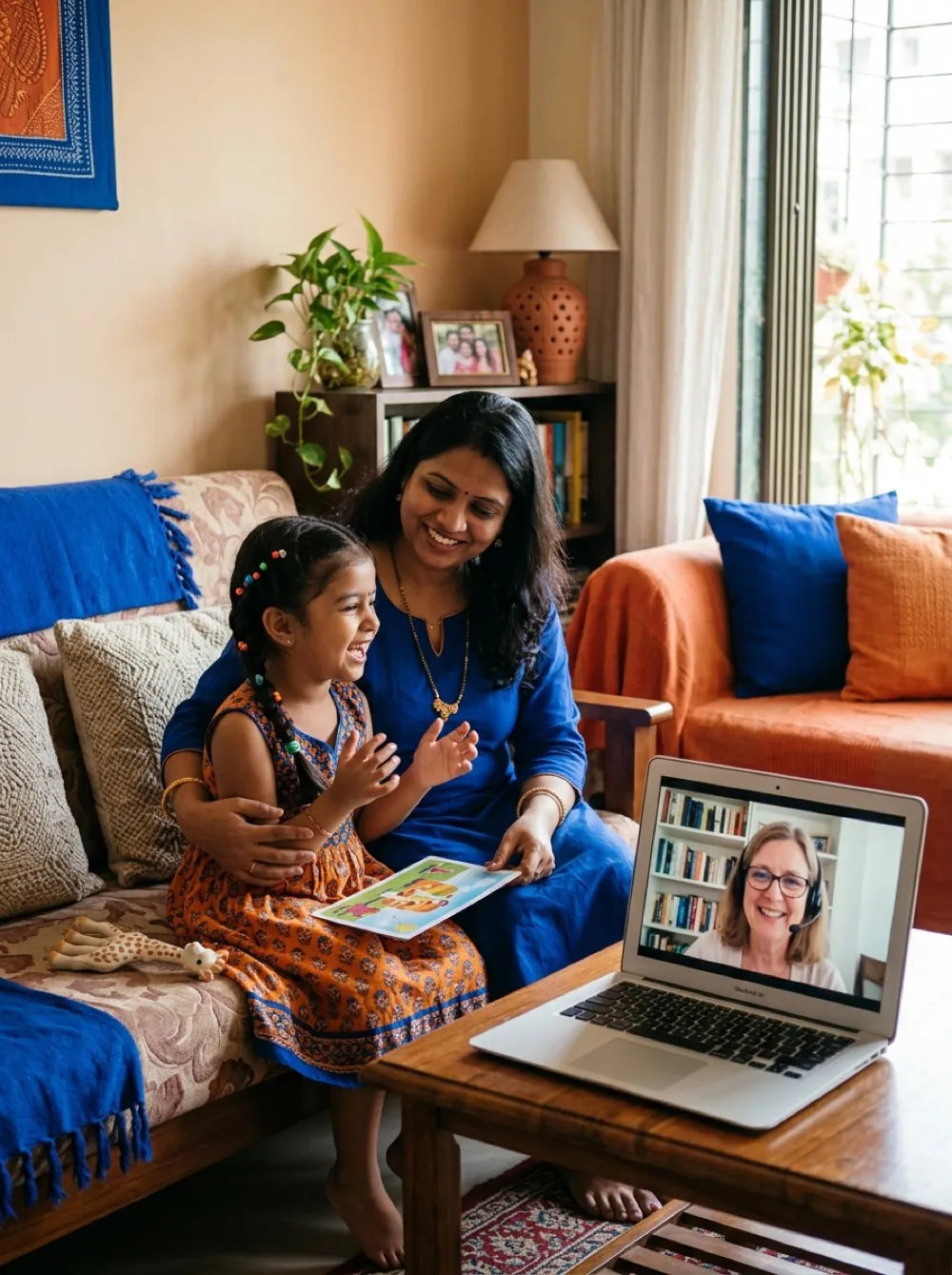
Every week we get the same WhatsApp message from parents — sometimes from Gandhinagar itself, often from smaller towns across Gujarat: “Can my child do speech therapy online, or do we have to travel?” The honest answer is: it depends on your child's age and condition. Online therapy is genuinely effective for many children and genuinely the wrong choice for some. Here is how we decide, openly, at our clinic.
Does online speech therapy actually work?
For the right child, yes. Tele-practice research over the past decade — accelerated enormously after 2020 — has repeatedly found that children receiving therapy by video for articulation errors, language delays and fluency problems make progress comparable to in-person therapy. That matches what we see in clinic: a motivated school-age child with a parent beside them often improves at the same pace online as across the table.
But the research has a quiet condition attached, and most advertisements skip it: outcomes are comparable when the child can engage with a screen and an adult facilitates at home. Online therapy is not a video to be watched; it is a live, structured session in which the therapist directs and the parent does much of the hands-on work. When that part is missing, results fall sharply.
Which children and conditions suit online therapy?
Age is the first filter. A child needs to sit before a screen for 20–30 minutes, attend to a face on video, and follow simple instructions — skills most children develop around 4–5 years. The condition is the second filter:
| Condition | Online suitability | Notes |
|---|---|---|
| Articulation errors (unclear “r”, “s”, “k” sounds) | Excellent | Camera close-ups of mouth positions work surprisingly well |
| Stammering / fluency | Excellent | Older children and teens often prefer the privacy of home |
| Mild language delay (age 4+) | Good | Parent must join every session and run daily practice |
| Toddler speech delay (under 3) | Parent-coaching only | Therapist trains the parent online; the parent therapies the child |
| Autism with attention difficulties | Limited | Usually needs in-person sessions first; online can follow later |
| Hearing-related speech delay | In-person first | Hearing must be tested and managed in clinic before any therapy |
When is in-person therapy the better choice?
We would rather lose an online booking than oversell it, so here is the honest list. Choose in-clinic sessions when your child is under 3 and not yet imitating; when autism, ADHD or sensory issues make screen attention very hard; when speech delay might be caused by hearing loss — that needs a proper audiological work-up, not a webcam; when feeding, drooling or oral-motor problems need physical guidance; or when you have tried 8–10 online sessions and seen no movement. A hybrid plan also works well: assessment and the first few sessions in clinic at Sargasan, then routine sessions online with a monthly in-person review.
What is the parent's role in online therapy?
In tele-therapy the parent is promoted from spectator to co-therapist, and this single factor decides outcomes more than the platform, the app or even the therapist's experience. Concretely, you will be asked to sit beside your child every session, position toys or picture cards as directed, repeat target words with correct emphasis, and run 15–20 minutes of practice daily between sessions — woven into meals, bathing and play rather than a separate “study hour”.
A pattern we see often at our Gandhinagar clinic: two children start online therapy in the same month with similar delays. In one home a parent treats the session as a class and leaves the room; in the other, the mother or father sits in, takes notes and practises daily. Within three months the second child is typically a stage ahead — same therapist, same condition, different parent involvement.
How do online sessions work and what do they cost?
Sessions run on a simple video call — a phone with stable 4G is enough, though a laptop helps. We share picture cards and worksheets on WhatsApp in advance, set weekly home targets, and track progress against the same milestones we use in clinic. Fees are in the same Rs.500–1,000 per session range as in-person therapy, and families in Mehsana, Patan or Himmatnagar save the travel that usually kills consistency. If you are weighing the options, start with online speech therapy for children in Gandhinagar — we will tell you frankly in the first assessment whether your child is a good tele-therapy candidate or needs clinic visits. Not sure if therapy is needed at all? Read our guide on the signs your child may need speech therapy, and if you are comparing providers, see how to choose the right speech therapist.
WhatsApp us about online therapy