
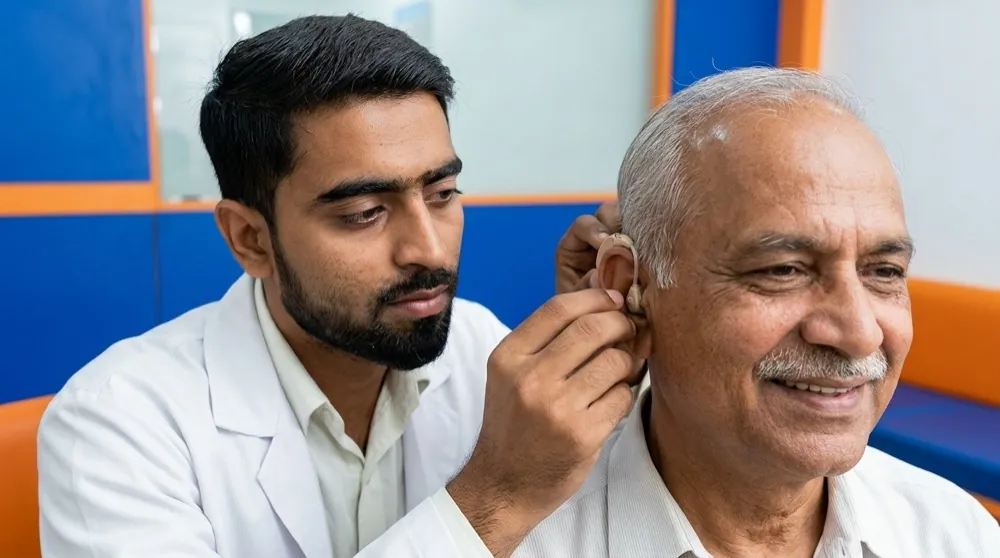
When a hearing test report says “severe” or “profound” hearing loss, families in Gujarat usually hear two solutions mentioned in the same breath: digital hearing aids and cochlear implants. They are not competing brands of the same product — they work in completely different ways, suit different ears, and carry very different costs. This guide explains how we help parents and adults choose at our Gandhinagar clinic.
What is the difference between a hearing aid and a cochlear implant?
A hearing aid is a tiny amplifier-computer worn in or behind the ear. It makes sound louder and clearer and sends it down the natural hearing pathway — so it works only when the inner ear still has enough usable hair cells to pass the signal on.
A cochlear implant bypasses the damaged inner ear entirely. A surgeon places an electrode inside the cochlea, and an external processor converts sound into electrical pulses that stimulate the hearing nerve directly. No surgery is involved with a hearing aid; an implant always requires an operation followed by months of programming (“mapping”) and listening therapy.
| Aspect | Hearing aid | Cochlear implant |
|---|---|---|
| How it works | Amplifies sound through the natural hearing pathway | Bypasses the inner ear and stimulates the hearing nerve electrically |
| Surgery | None — fitted and programmed in clinic | Required, followed by months of mapping and therapy |
| Best suited for | Mild to severe loss with usable inner-ear hearing | Severe-to-profound loss where aids give little speech clarity |
| Typical cost in India | Roughly ₹15,000–₹3,00,000 per ear by technology level | Several lakhs for device, surgery and mapping; ADIP / RBSK schemes may help eligible children |
| Time to benefit | Days to weeks after fitting | Months of mapping and listening therapy after surgery |
When is a hearing aid the right choice?
For the large majority of patients — mild, moderate, and most severe losses — properly fitted hearing aids are the answer. If your audiogram shows usable hearing and your speech understanding improves meaningfully with amplification, modern digital aids will almost always serve you better, faster, and far more affordably than surgery. This is why we insist on a complete hearing test (PTA) in Gandhinagar and a real-world hearing aid trial before anyone mentions an implant.
A pattern we see often at our Gandhinagar clinic: parents arrive convinced an implant is the only hope, because “severe loss” on a report sounds final. After a careful aided trial, many of these children turn out to hear speech well with powerful digital hearing aids — and surgery comes off the table entirely.
Who actually needs a cochlear implant?
A cochlear implant is considered when both of these are true:
- The loss is severe-to-profound sensorineural in both ears, and
- Even well-fitted, powerful hearing aids give little or no useful speech understanding after a fair trial.
In children this is usually picked up early through newborn screening followed by a BERA / ASSR test for babies, which measures the hearing nerve’s response objectively — no cooperation from the baby needed. In adults, implants help most when hearing was lost after learning language (for example, after progressive loss, infection, or ototoxic medicines).
Hearing aid vs cochlear implant for a child: why timing matters most
For a baby born with profound loss, the brain’s language window is the deciding factor. The typical pathway is: confirm the loss with BERA, fit hearing aids immediately, monitor progress closely, and — if aided responses remain poor — proceed to implantation early, ideally within the first two to three years of life. Children implanted early and given consistent auditory-verbal therapy can develop spoken language remarkably close to their hearing peers. The implant alone does not do this; therapy after surgery is half the treatment.
What do hearing aids and cochlear implants cost in India?
Digital hearing aids in India range roughly from the price of a basic smartphone to a premium one per ear, depending on technology level. A cochlear implant — device, surgery, and initial mapping — runs into several lakhs of rupees. For eligible children, government schemes such as ADIP and Gujarat’s RBSK programme can cover much of the implant cost; eligibility rules change, so ask us and we will guide you to the current process and the right implant centres.
How we help you decide at our Gandhinagar clinic
We do not perform implant surgery — and that is exactly why our advice is unbiased. We run the full candidacy work-up (PTA, impedance, BERA/ASSR, aided testing), supervise an honest hearing aid trial, refer genuine candidates to experienced implant surgeons, and then handle the long-term part that matters most: post-implant mapping support and auditory-verbal rehabilitation right here in Sargasan, Gandhinagar.
Frequently asked questions
Can a cochlear implant restore normal hearing?
No device restores natural hearing. An implant provides a new, electronic way of hearing that the brain learns to interpret over months of therapy. Speech understanding can become excellent, but honest counselling — not miracle promises — is what families deserve.
Is a cochlear implant better than a hearing aid?
Neither is “better” — they suit different degrees of loss. If hearing aids give you good speech clarity, they are the right choice. An implant is reserved for ears that hearing aids genuinely cannot help.
At what age should a deaf child get a cochlear implant?
The earlier the better once candidacy is confirmed — most teams aim for implantation between 1 and 3 years of age, because the brain learns language fastest in these years. A failed hearing aid trial and BERA confirmation come first.