
Gujarat’s GIDC belts — from Gandhinagar’s industrial sectors to Chhatral, Kalol and beyond — run on machines that never whisper: power presses, looms, CNC shops, compressors, generators, grinders. The workers who run them often tell us the same thing at their first hearing test: “The noise stopped bothering me years ago.” That is precisely the problem. The noise stopped bothering them because the ear cells that used to hear it are gone.
How loud is too loud at work?
You do not need a sound level meter for the first check — use the arm’s length test. If you have to raise your voice to be understood by someone standing an arm’s length away, the ambient noise is likely 85 dB or more, the level at which hearing damage begins with daily 8-hour exposure. If you must shout directly into their ear, you are probably at 95 dB or worse. By that simple test, a large share of machine-floor jobs in any industrial estate sit in the damaging zone every single shift.
Why does occupational hearing loss creep in silently?
Noise damage has three cruel properties. It is painless — nothing hurts while the hair cells die. It is gradual — you lose a sliver each year, too little to notice. And it starts at 4000 Hz, a high pitch you do not use for everyday awareness, so your “hearing” feels fine long after the audiogram shows a deep notch. By the time speech sounds like mumbling — especially women’s and children’s voices, and conversations in a noisy room — the loss has typically been growing for five to ten years. Many workers also develop a constant ring or hiss (tinnitus) that follows them home from the factory and never clocks out.
What does the 85 dB / 8-hour rule mean?
Safe exposure is a trade-off between loudness and time: the louder the sound, the shorter the safe duration. International occupational guidelines treat 85 dB for 8 hours as the daily limit, and every 3 dB increase cuts the safe time in half. Indian factory rules set the legal ceiling at 90 dB(A) for an 8-hour shift — and exposure above that without protection is a violation, not a normal working condition.
| Noise level | Typical source on the floor | Safe exposure without protection |
|---|---|---|
| 85 dB | Busy workshop, packing lines | 8 hours |
| 88 dB | Lathe section, blowers | 4 hours |
| 91 dB | Power looms, compressors nearby | 2 hours |
| 94 dB | Grinding, cutting work | 1 hour |
| 100 dB | Power press, pneumatic hammering | ~15 minutes |
| 110 dB+ | Metal stamping at close range | ~1–2 minutes |
Read that last column again: a worker beside a 100 dB press uses up a full day’s safe noise dose in the first fifteen minutes of the shift. The remaining seven-plus hours are pure damage unless ears are protected.
Is annual audiometry your legal right?
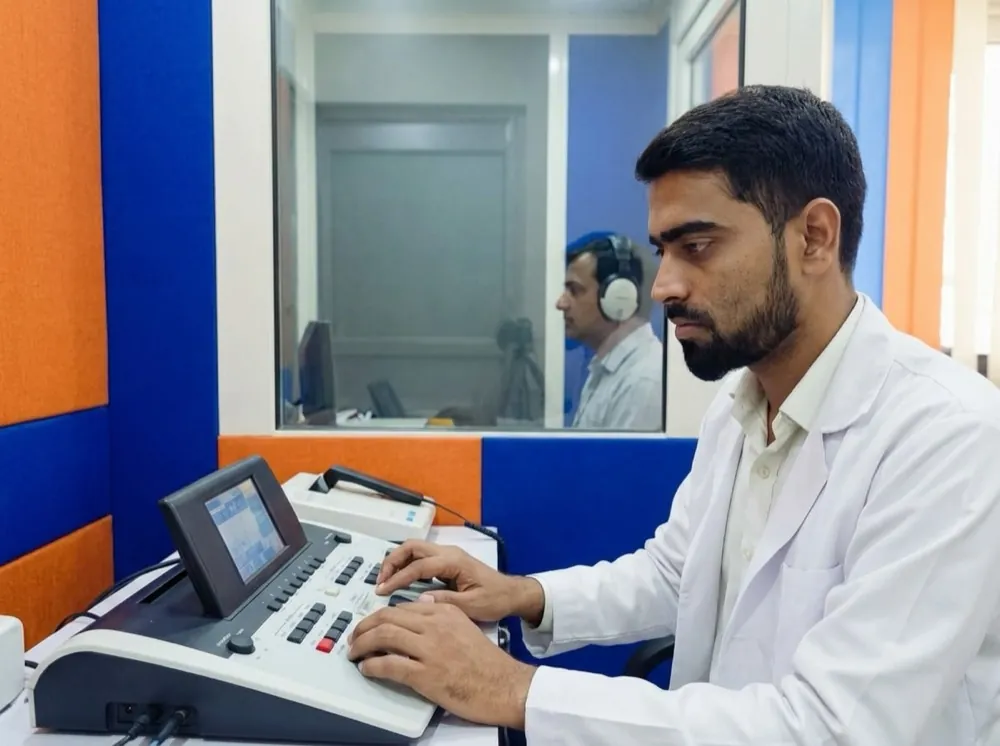
Largely, yes. Under the Factories Act framework, noise-induced hearing loss is a notifiable occupational disease, and rules for hazardous and noisy processes require pre-employment and periodic medical examination — including audiometry — for exposed workers. Workers covered by ESIC can also claim compensation for occupational deafness, but claims stand or fall on documented audiograms. Practically, this means two things: ask your safety officer when the last hearing-conservation audit happened, and keep a personal copy of every hearing report. A baseline hearing test (PTA, audiometry) in Gandhinagar costs Rs. 300–800, takes about thirty minutes, and gives you the reference point every future comparison — and any future claim — depends on.
Which ear protection do workers actually wear?
The best earplug is not the one with the highest rating — it is the one that stays in for the whole shift. Foam plugs (Rs. 50–200) give 20–30 dB of reduction but only when rolled tight, inserted deep and reinserted after breaks; most workers we test wear them too loosely to help. Earmuffs (Rs. 500–2,000) are easier to use correctly and easy for supervisors to verify at a glance, but get sweaty in Gujarat summers. Custom-moulded silicone plugs (roughly Rs. 1,500–3,500) fit an individual ear, last years, and are the option workers complain about least — which, in hearing conservation, is what “best” really means. Whatever the choice, the rule is total: protection worn 100 percent of noisy time, because even short unprotected bursts restart the damage.
A pattern we see often at our Gandhinagar clinic: a machine operator in his early forties, fifteen years on the floor, brought in by his wife because the TV volume has become a family dispute. His audiogram shows the classic deep notch at 4000 Hz in both ears. He never had a single hearing test through his working life — his factory’s annual check covered eyes and blood pressure but skipped ears. Had the first audiogram happened in year three instead of year fifteen, protection could have saved most of what he lost.
To understand your report and what kind of loss noise causes, read our guides to the PTA test and how it works and the different types of hearing loss. And if you or your unit wants to organise testing for a group of workers, message us on WhatsApp (88776 72821) — we will guide you on the practical options.
Book a baseline audiometry test