
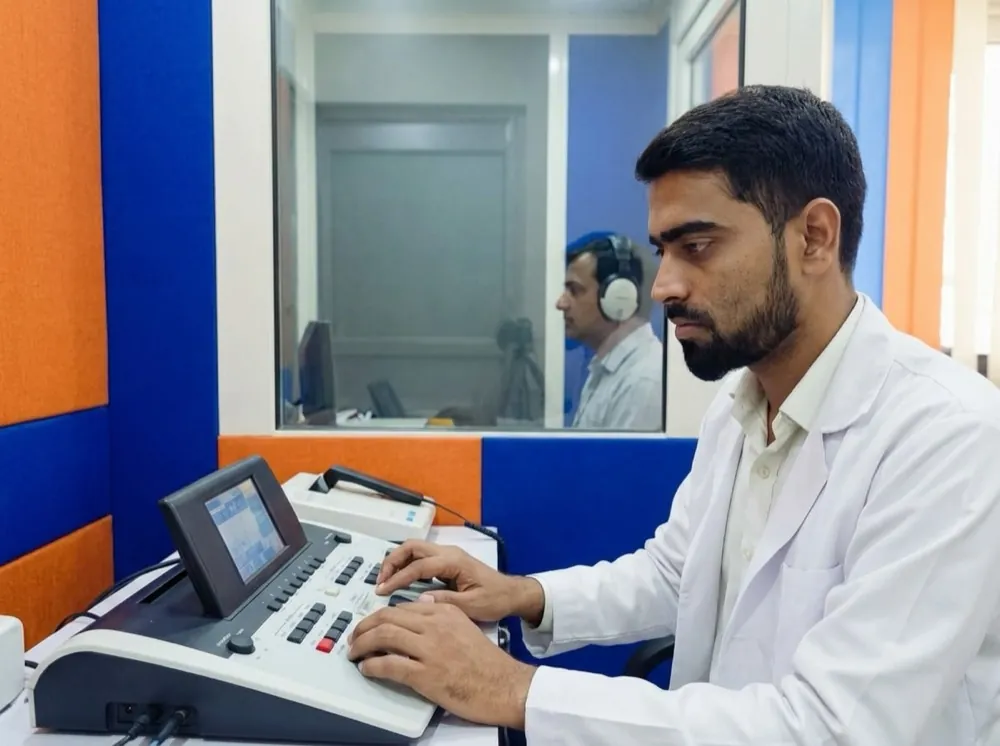
Families usually arrive at the cochlear implant question from one of two directions. Either a newborn screening and BERA test has confirmed profound hearing loss in a baby, or an adult has watched hearing aids help less and less each year. In both cases the question is the same: who actually qualifies for a cochlear implant — and who decides? The honest answer is that candidacy is a process, not a single test result, and understanding that process saves families months of confusion.
Is profound hearing loss alone enough to qualify?
No — and this surprises many families. The audiogram is the entry gate, not the verdict. Modern candidacy rests on three pillars:
- Degree and type of loss: severe-to-profound sensorineural loss in both ears, confirmed by multiple tests that agree with each other.
- Limited benefit from hearing aids: even with the best-fitted aids, speech remains unclear. This is measured, not assumed.
- A working hearing nerve and an implantable cochlea: confirmed on CT and MRI by the implant surgeon.
A person with profound loss whose hearing aids still deliver good speech understanding is usually not a candidate. Equally, someone with a slightly better audiogram but very poor speech clarity may qualify. The question the team keeps asking is not “how loud must sound be?” but “can this ear deliver usable speech to the brain by any non-surgical means?”
Why is the hearing aid trial compulsory?
Every credible implant programme insists on a supervised hearing aid trial — typically three to six months — before recommending surgery, and parents sometimes feel this is wasted time. It is not. The trial does three jobs. First, it protects the patient: implantation sacrifices most residual natural hearing in that ear, so the team must prove aids genuinely fail before removing that option. Second, it generates the evidence: aided audiograms and speech or listening-response measures during the trial are exactly the documents insurance companies and government schemes such as ADIP ask for. Third, in young children the trial period doubles as early therapy — the child learns to wear a device, sit for testing and attend to sound, all of which makes post-implant rehabilitation faster.
Which tests make up the candidacy battery?
At our clinic the audiological work-up usually runs across two or three visits. Here is what each test contributes and what it typically costs in Gujarat:
| Test | What it tells the team | Typical cost |
|---|---|---|
| Pure tone audiometry (PTA) | Degree and pattern of hearing loss in each ear | Rs. 300–800 |
| Tympanometry | Rules out middle-ear problems that surgery cannot fix and medicine can | Often clubbed with PTA |
| OAE | Checks outer hair cell function in the cochlea | Usually part of the battery |
| BERA / ASSR | Objective, sleep-based confirmation of the loss in babies and young children | Rs. 1,500–3,500 |
| Aided audiometry & speech tests | Measures real benefit from hearing aids — the heart of candidacy | Done during the trial |
| CT / MRI of inner ear | Confirms the cochlea and hearing nerve can accept an implant | At the surgical hospital |
Children also receive a speech and language evaluation, because the implant team needs a baseline to plan therapy. Adults are tested with sentence-level speech material in the language they actually live in — Gujarati or Hindi scores matter more than English word lists for most of our patients.
What can disqualify or delay a candidate?
A few findings genuinely rule an implant out: an absent hearing nerve, a cochlea that never formed, or active middle-ear infection that must be treated first. More often, the team asks a family to wait and prepare rather than saying no — for example, when a child has not yet completed a proper hearing aid trial, or when no one in the family can commit to the weekly auditory training the implant demands afterwards. An implant without rehabilitation is, bluntly, an expensive disappointment; surgeons and audiologists weigh the family’s commitment as seriously as the audiogram.
A pattern we see often at our Gandhinagar clinic: a family arrives convinced their child “failed” candidacy because a hospital asked for a hearing aid trial first, and they treat it as rejection. In most of these cases the child was never rejected at all — the trial is step one of candidacy. Once the aids are fitted properly and reviews are documented, the same hospital moves them forward without resistance.
What happens after the tests say yes?
Candidacy is confirmed jointly by the audiologist, the ENT implant surgeon and, for children, the speech-language pathologist. The family then chooses a device, completes imaging and fitness checks, and plans for surgery — followed by switch-on about three weeks later and months of mapping and listening therapy. That rehabilitation phase is where outcomes are actually made, and it can be done close to home: our cochlear implant rehabilitation programme in Gandhinagar handles the post-surgery mapping coordination and auditory training so families are not travelling to a metro every week. If you are still at the comparison stage, our plain-language hearing aid vs cochlear implant guide explains when each device wins, and parents of babies awaiting testing can read our parents’ guide to the BERA test to know what the confirmation step looks like.
Explore cochlear implant rehab at Renuka Clinic