
Teaching is one of the heaviest vocal jobs there is — five to six hours of projected speech a day, over ceiling fans and forty children, often in chalk dust, with almost no silence between periods. So it is no surprise that by Thursday the voice turns rough, by Friday the throat aches, and by Sunday evening it has just about recovered in time to be strained again. Common, yes. Normal, no. A voice that follows this weekly cycle is asking for help — and if it is ignored long enough, it starts developing nodules. This guide covers what is happening, how to protect your voice inside a real Indian classroom, and when to get professional help.
Why does your throat hurt by Friday?
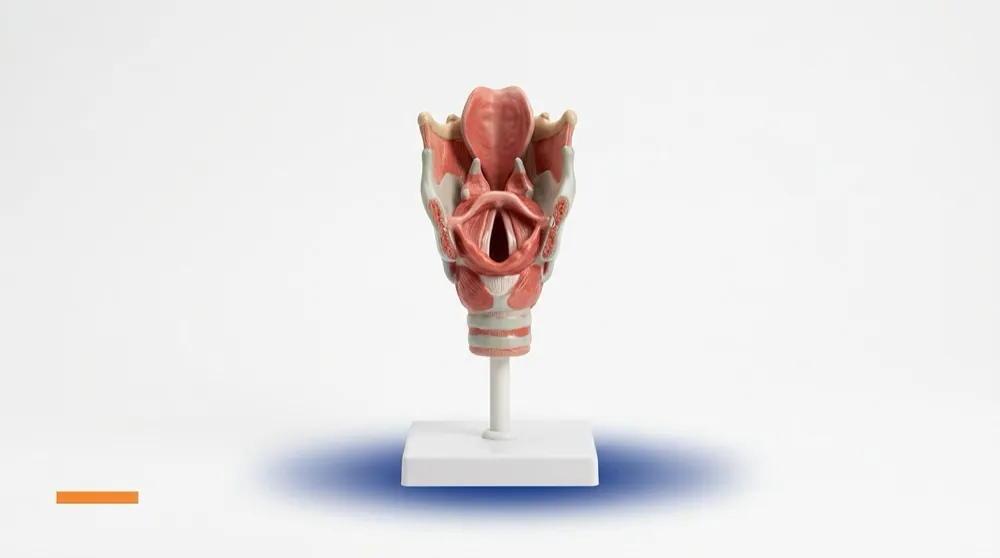
Your vocal folds are two small bands of muscle and delicate lining that collide hundreds of times per second when you speak — and far harder when you speak loudly. A teacher’s week gives them the workload of a professional singer with none of the training, microphones or rest. Add the dehydrating effect of chai between periods, dusty air, and the habit of clearing the throat (which slams the folds together), and by Friday the lining is swollen and bruised. The weekend repairs it partially; Monday begins the damage again. Pain and evening hoarseness are not weakness — they are the folds reporting an overload that needs managing, exactly like a knee complaint in someone who stands all day.
What are the early signs that nodules are forming?
Vocal nodules are small calluses that grow where the folds hit each other hardest — the body’s response to repeated collision. Caught early, they usually reverse with therapy; ignored, they harden. Watch for this sequence:
- The voice is fine in the morning but rough and effortful by the last period.
- Friday hoarseness starts arriving on Wednesday, then never fully clears on weekends.
- Your pitch breaks or the voice cuts out on loud or high notes — prayer assembly, calling a student across the ground.
- Talking starts to feel like physical work, with tightness in the throat and neck.
- Colleagues ask if you have a cold when you do not.
Hoarseness that persists beyond two to three weeks — whatever the cause — deserves an ENT examination of the folds (laryngoscopy) rather than another lozenge.
How do you save your voice in the classroom?
| Classroom habit | Why it damages the voice | Voice-safe alternative |
|---|---|---|
| Shouting over a noisy class | Maximum-impact collisions of the folds | A clap pattern, bell or raised hand signal; wait for quiet before speaking |
| Talking non-stop for the full period | No recovery time between collisions | Build in two-minute written tasks or pair work as micro-rest for the voice |
| Chai or coffee all day, little water | Caffeine dehydrates the fold lining | Bottle on the desk; a sip every 15–20 minutes of talking |
| Constant throat clearing | Slams the folds together | Sip water and swallow, or hum gently — the tickle usually passes |
| Whispering when hoarse | Squeezes the folds in a strained position | Quiet, relaxed normal voice — or genuine silence |
| Dry chalk dust and duster-banging | Irritates the airway lining all day | Damp duster, marker board where available, stand clear while cleaning |
One more upgrade worth its price: a small portable voice amplifier — a clip-on microphone with a waist speaker, widely available for roughly Rs.1,500–3,000. For a teacher taking six periods a day it does what a helmet does for a rider: it removes the daily trauma at the source. Many schools will sanction one faster than you expect if a therapist’s note recommends it.
What does voice therapy actually involve?
Voice therapy is structured retraining, not throat massage and not surgery. A speech-language pathologist first assesses how you breathe, pitch and project, then teaches techniques — breath-supported speech, easy onset, forward resonance — that let you fill a classroom at a fraction of the strain. Sessions typically cost Rs.500–1,000, run weekly, and most teachers feel the difference within four to six sessions; online sessions work well for working teachers who cannot travel on school days. If you are comparing options, our guide on how to choose a speech therapist lists the questions worth asking first — and remember that adult speech and voice problems respond to therapy at any age, as our article on stammering treatment for adults makes clear.
When is hoarseness more than tiredness?
See a professional promptly — not after the term ends — if hoarseness lasts beyond two to three weeks, if there is pain on speaking or swallowing, a feeling of something stuck in the throat, breathing difficulty, or if you smoke or chew tobacco and the voice has changed at all. These need the folds examined directly before therapy begins.
A pattern we see often at our Gandhinagar clinic: a primary school teacher with eight or ten years of service whose “Friday voice” has quietly become her everyday voice, who has been managing on honey, mulethi and one strepsil per period. Assessment shows early nodule changes; a term of weekly therapy, a water schedule and a Rs.2,000 amplifier later, the evening voice is back — without a day of leave or a surgeon involved. The earlier that visit happens, the simpler the fix.
If your voice is not lasting the week, book an evaluation with our voice and swallowing therapy in Gandhinagar — assessment, classroom-specific vocal hygiene and a therapy plan, with online sessions available for working teachers.