
Every swallow you take is a small feat of engineering: the throat must close the airway, open the food pipe and push food past the windpipe entrance in under a second. With age, stroke, Parkinson’s disease or dementia, that timing weakens — and food or liquid starts slipping towards the lungs. Doctors call it dysphagia. Families usually call it “he eats slowly now” or “she always coughs with water”. This article is written to change how seriously those small sentences are taken.
Is coughing at meals just a part of old age?
No — and this is the single most important message of this article. Coughing while eating or drinking means something touched the entrance of the airway. The cough is actually the body’s defence working. Occasional coughing when talking and eating together happens to everyone; coughing at most meals, or reliably with thin liquids like water, chai or dal, means the swallowing mechanism is no longer protecting the airway properly. That is a medical sign, exactly like chest pain on climbing stairs — common in the elderly, yes, but never “normal”.
What is silent aspiration — and why is it more dangerous than coughing?
In many elderly people, the throat’s sensation also weakens. Food and liquid then enter the windpipe without triggering any cough at all — this is silent aspiration, and it is the truly dangerous form because nobody sees it happen. The clues are indirect: a wet, gurgly voice after meals, a mild fever that keeps returning, gradual weight loss, and chest infections that are treated, resolve, and come back within weeks. Each “chest infection” may actually be aspiration pneumonia — lung infection caused by food and saliva going the wrong way at every meal.
Which warning signs should families watch for?
| What you notice | What it may mean |
|---|---|
| Coughing or throat clearing during or just after meals | Liquid or food reaching the airway entrance |
| Wet or gurgly voice after eating or drinking | Residue sitting on the vocal cords — a strong aspiration clue |
| Meals taking 45+ minutes; food held in the mouth | Weak chewing and delayed swallow trigger |
| Avoiding rotla, dry foods, or drinking water with every bite | Self-compensation for poor food transport |
| Repeated chest infections, unexplained fevers, weight loss | Possible silent aspiration — needs assessment soon |
What does a swallow assessment involve?
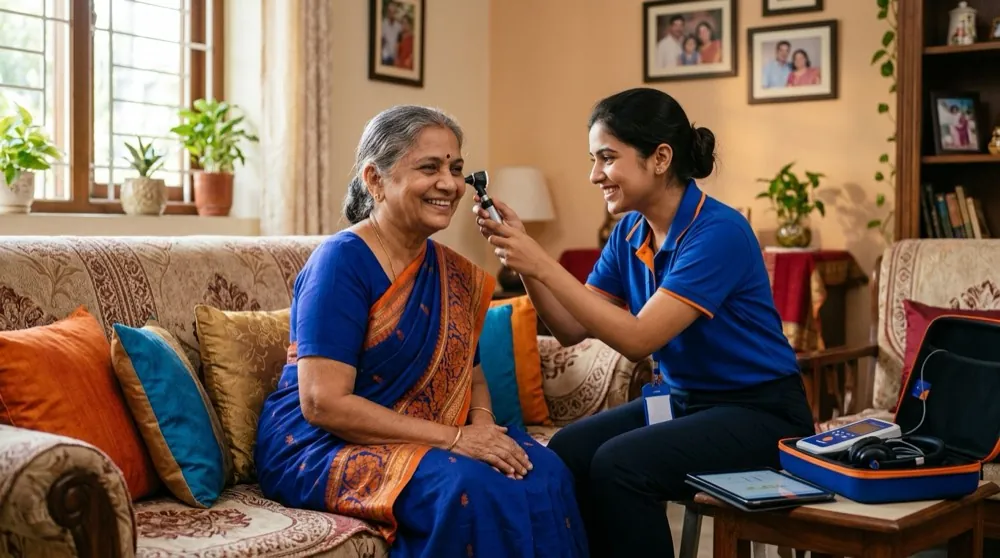
A clinical swallow assessment by a speech-language pathologist is simple and painless. We check the strength and movement of the lips, tongue and throat muscles, listen to the voice, and then observe the person swallowing carefully graded textures — thickened liquid, soft solid, thin liquid — while watching for delay, residue, voice change and oxygen-level dips. Based on this we recommend the safest food and liquid textures, feeding positions and exercises, and refer for an ENT or video-fluoroscopy examination where needed. Because travelling is hard for many elderly patients, we also conduct swallowing assessment in Gandhinagar as a home visit — the person eats in their own chair, with their own food, which often gives a truer picture than a clinic.
A pattern we see often at our Gandhinagar clinic: an elderly parent admitted twice in six months for “pneumonia”, treated with antibiotics each time, sent home — and readmitted. Nobody connected the infections to the mealtime coughing the family had watched for two years. Once a swallow assessment identified the unsafe textures and the family adjusted food consistency and feeding posture, the cycle of admissions stopped. The pneumonia was never really a lung problem; it was a swallowing problem arriving in the lungs.
What can families do at mealtimes starting today?
- Sit fully upright for every meal — 90 degrees in a chair, never reclining in bed, and stay upright 30 minutes after eating.
- No talking, TV debates or laughing mid-bite. Distraction is when most choking happens.
- Small bites, slow pace, one swallow at a time — and check the mouth is empty before the next spoon.
- Alertness first. Never feed a drowsy person; skip the meal timing rather than feed half-asleep.
- Do not force water during coughing fits — thin water is usually the hardest thing for a weak swallow to control.
These steps reduce risk but do not replace assessment — the right food textures differ from person to person, and guessing has a real cost. If the swallowing trouble began after a stroke, our companion guide on swallowing therapy after stroke walks through the recovery stages. And since hearing loss often isolates the same age group at the same dinner table, see our article on hearing aids for the elderly.
WhatsApp us for a swallow assessment