
Of all the changes a stroke brings, losing speech is the one families describe as the most heartbreaking — the person is right there, awake, looking at you, and the words will not come. The medical name is aphasia, and the two most important facts about it are also the most comforting: intelligence is usually intact, and recovery is real, especially when therapy starts early and the family becomes part of it. This guide covers what hospitals rarely have time to explain.
What is aphasia — and how is it different from dysarthria?
Two very different problems get called “speech loss”, and they need different therapy, so the distinction matters from day one:
| Aphasia | Dysarthria | |
|---|---|---|
| What is affected | The brain’s language system — finding words, building sentences, understanding, reading, writing | The speech muscles — lips, tongue, voice box are weak or poorly coordinated |
| How it sounds | Halting speech, wrong or jumbled words, or fluent speech that makes little sense | Slurred, slow, soft or nasal speech — but the right words in the right order |
| Understanding | May also be affected, fully or partly | Usually normal |
| Writing as a clue | Writing is affected too — it is a language problem | Writing is fine if the hand works — it is a muscle problem |
| Therapy focus | Rebuilding language: naming, sentence work, comprehension, communication strategies | Strengthening and coordinating muscles, breath support, pacing, clarity drills |
Many stroke survivors have a mixture of both. A speech-language pathologist’s evaluation in the first weeks identifies the blend and sets the therapy plan accordingly.
Why are the first six months called the golden period?
After a stroke, the brain enters a phase of heightened rewiring — surviving regions take over work from damaged ones, and this neuroplasticity is at its peak in roughly the first three to six months. Therapy during this window acts like a guide for the rewiring: each naming drill and conversation exercise tells the brain which connections to rebuild first. Spontaneous improvement also happens in this period, which sometimes tempts families to wait and watch — but therapy plus spontaneous recovery consistently goes further than spontaneous recovery alone. And a crucial correction to something families are often told: improvement does not stop at six months or one year. It slows, but motivated patients keep gaining words and confidence for years.
How should family members talk to someone with aphasia?
In aphasia, the family is half the therapy. The same loving instincts that make relatives finish sentences and answer on the person’s behalf are, unfortunately, the exact habits that slow recovery. The working rules:
- Do give time — lots of it. Count a slow ten in your head after asking anything. The word-finding machinery is slow, not absent, and rushing shuts it down.
- Don’t finish their sentences. Every sentence you complete is a retrieval attempt their brain did not get to make.
- Do speak in short, adult sentences. One idea at a time, normal volume. Aphasia is not deafness, and it is not childishness — never use baby talk.
- Do ask yes/no or either/or questions when open questions stall: “Chai or coffee?” is answerable; “What do you want?” may not be.
- Do welcome every channel — gestures, pointing, drawing, writing a first letter. Communication first, perfect speech later.
- Don’t correct every error or demand repetition. Respond to the meaning. If he says “beta” but means “bhai”, and you understood, the conversation succeeded.
- Don’t talk about the person in front of them. Comprehension is often far better than speech — assume everything is understood, because it usually is.
- Do keep them in the conversation at meals and gatherings. Isolation is the biggest hidden enemy of language recovery.
What does speech therapy for aphasia actually involve?
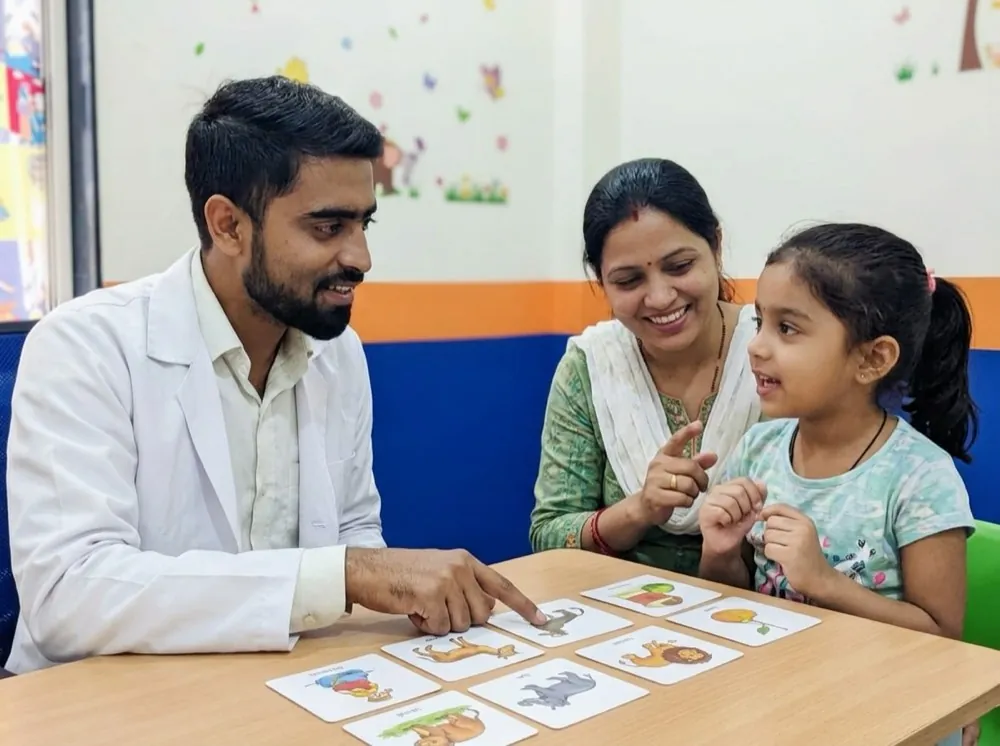
After a detailed assessment, therapy is built around the person’s specific gaps: naming drills with cues that are gradually withdrawn, sentence-construction work, comprehension tasks, reading and writing practice, and conversation-level practice with the family trained as communication partners. Sessions at our clinic cost Rs.500–1,000, and we run structured speech therapy for aphasia in Gandhinagar alongside online sessions for families outside the city and home visits for patients with limited mobility. Practical home practice between sessions multiplies the effect — our guide to speech therapy exercises at home shows how families can support daily practice correctly.
A pattern we see often at our Gandhinagar clinic: a retired gentleman brought in four months after his stroke, speaking in single words, with a devoted family that had been lovingly answering every question for him — at the doctor’s, at the dinner table, on the phone. Within weeks of therapy plus one change at home (everyone waits, nobody finishes sentences), the single words become short phrases. The therapy mattered; the family’s new silence mattered almost as much.
What about swallowing and other stroke problems?
Speech and swallowing share the same neighbourhood in the brain and the same muscles in the throat, so many aphasia patients also need dysphagia care — if mealtimes involve coughing or a Ryle’s tube, read our companion roadmap on swallowing therapy after stroke. Treating both together, early, is how a stroke survivor returns not just to talking, but to the family table where the talking happens.
WhatsApp us about aphasia therapy