
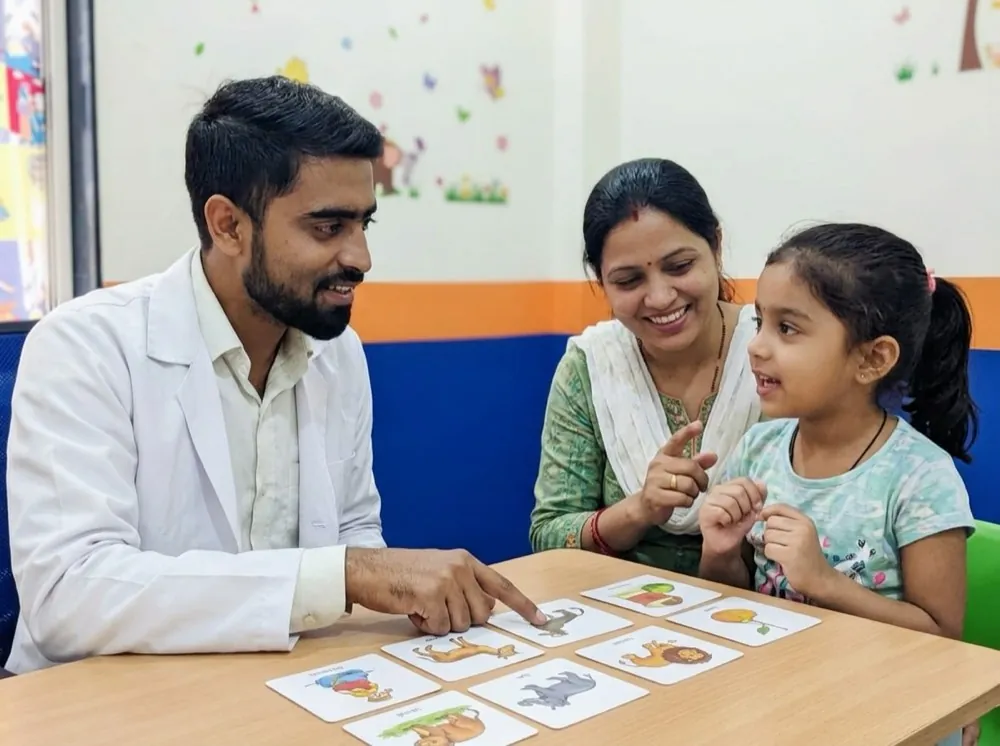
In most Gandhinagar households a child hears at least two languages before their second birthday — Gujarati with grandparents, Hindi from television and neighbours, English at playschool. And in most of those households, the moment the child seems slow to talk, someone confidently announces the cause: “Too many languages. Speak only one.” It is among the most common pieces of advice we hear repeated in our clinic — and among the most consistently wrong.
Does hearing two languages confuse a child?
No. Decades of research on bilingual children, across many language pairs, shows they babble, say first words and form two-word phrases on essentially the same timeline as single-language children. A bilingual brain is not dividing one fixed quantity of “language ability” between two languages; it is building one language system with two surfaces. There is a real nuance worth being honest about: a bilingual toddler may know fewer words in each language at a given age — but count the words across both languages and the total matches monolingual peers. If your daughter says “pani” but not “water”, she has that word.
Is mixing Gujarati and English in one sentence a problem?
“Mumma, mane ball joïe, the red one!” — sentences like this make some parents anxious, but code-mixing is one of the most normal features of bilingual development, not a symptom of confusion. Children mix for practical reasons: a word arrives faster in one language, or they have only learned it in one. Notice that bilingual adults all around Gujarat mix Gujarati, Hindi and English in every conversation — nobody calls that a disorder. As each language grows, children separate them, and by school age they switch by listener: Gujarati with dadi, English with the teacher, often within the same minute.
Should you drop one language if speech seems delayed?
This is the advice relatives give most and the one we most want to retire. If a bilingual child has a genuine speech delay, the bilingualism is not the cause — delayed bilingual children are delayed in both languages, and a true underlying issue (hearing loss, a language disorder, autism) shows up no matter how many languages are in the house. Dropping Gujarati does not treat any of these; it just cuts the child off from grandparents, and often forces parents to model the language they themselves speak less naturally — giving the child a weaker, stilted version instead of a rich one. A child learns best from the language their family speaks with full fluency and feeling.
| Normal in bilingual children | Red flag in any language |
|---|---|
| Mixing two languages in one sentence | No words at all by 16–18 months |
| Fewer words per language, normal combined total | Combined vocabulary across both languages clearly behind |
| A quiet phase when a new language is introduced | No two-word phrases in either language by age 2 |
| Preferring one language for certain topics | Loss of words or skills the child once had |
| Switching language by listener | Not responding to name; poor understanding in both languages |
What is the one-person-one-language strategy?
If you want structure, the simplest evidence-backed approach is one person, one language: each person speaks their most natural language to the child, consistently. Mummy always Gujarati, an English-fluent papa or didi always English, dadi-dada always Gujarati — and school provides English immersion anyway. The child quickly maps language to person, which makes separation easier. A home-language/school-language split works just as well. The only real rule: be consistent, and let each speaker use the language they are genuinely fluent in — quality of input matters far more than which language it is.
How do you tell bilingual normal from a real delay?
Apply the same milestone clock you would to any child, counting both languages together: babbling by 9–12 months, first words by 16–18 months, 50-plus combined words and two-word phrases by age 2, and understanding that matches age in at least the home language. A pattern we see often at our Gandhinagar clinic: a two-and-a-half-year-old is brought in “because two languages confused him”, the family already having dropped Gujarati on advice from relatives — and testing reveals an unrelated cause, most often a hearing issue or a language delay that was present in both languages all along. The bilingual home was never the problem; it was just the most visible thing to blame, and blaming it delayed the real assessment.
If milestones are missing in both languages, do not drop a language — book a bilingual-aware speech therapy assessment in Gandhinagar. Our checklists on the signs a child needs speech therapy and how to choose a speech therapist can help you prepare. Or simply WhatsApp us on 88776 72821 — we assess in Gujarati, Hindi and English, so your child is evaluated in the languages they actually live in.