
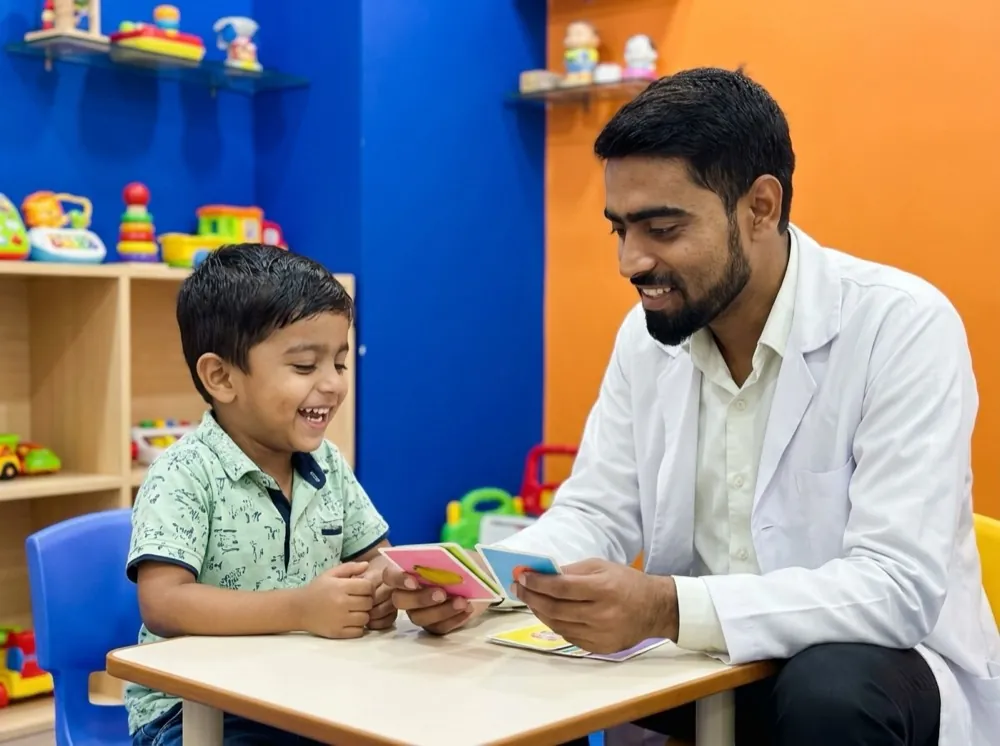
Every year, RBSK health teams quietly screen lakhs of children across Gujarat — and every year, referral slips for “suspected hearing problem” or “speech delay” come home in school bags and are never acted upon, simply because parents have never heard of the scheme. If your child has received one of these slips, or you suspect a hearing or speech problem and money is the barrier, this guide is for you.
What is the RBSK scheme and which children are covered?
Rashtriya Bal Swasthya Karyakram is the Government of India’s child health screening and early intervention programme, run in Gujarat alongside the state’s school health programme. It targets the “4 Ds” — defects at birth, diseases, deficiencies, and developmental delays including disabilities. Coverage works in three bands: newborns are screened at delivery points and during ASHA home visits; children up to six years are screened at anganwadi centres, roughly twice a year; and students aged six to eighteen in government and grant-aided schools are screened at least annually by dedicated mobile health teams.
Which hearing and speech problems does RBSK screen for?
Among the 30+ listed conditions, several sit squarely in our field: congenital deafness, ear conditions such as chronic discharging ears that quietly damage hearing, speech and language delay, and developmental conditions like autism where communication is affected. The school screening is deliberately simple — questions, observation, basic checks — so it does not diagnose anything. What it does brilliantly is flag the child who needs proper testing, which is exactly the child who would otherwise reach an audiologist at age ten instead of age six. If you are unsure what to watch for at home, our checklist of signs that a child needs speech therapy is a good companion to the school screening.
What should you do with the referral slip?
The slip is not a formality — it is a ticket. It refers your child to the District Early Intervention Centre (DEIC), usually located at the district civil hospital, where a team that can include a paediatrician, audiologist, psychologist and therapist assesses the child free of cost. Here is the pathway from slip to treatment:
| Stage | What happens | Cost to you |
|---|---|---|
| 1. School/anganwadi screening | RBSK mobile team flags a suspected problem, issues referral slip | Free |
| 2. DEIC visit | Detailed assessment — hearing tests (OAE/BERA), speech evaluation | Free |
| 3. Diagnosis & plan | Condition confirmed; treatment or therapy plan made | Free |
| 4. Treatment | Medicines, surgery, hearing aids or therapy at empanelled facilities | Free for eligible children |
Carry the slip, the child’s Aadhaar or ID, the school name and any earlier medical papers. If the slip has been lost, the school’s RBSK visit register or the taluka health office can re-issue the reference — do not let a lost paper end the process.
What treatment is actually free under RBSK?
More than most parents expect. Confirmed conditions are treated at government and empanelled hospitals without charge — ear infections and surgeries, hearing aids for eligible children, speech and developmental therapy through the DEIC, and, in suitable young children with severe-to-profound loss, government-funded cochlear implant surgery with rehabilitation — support worth several lakhs of rupees. The honest caveats: DEIC therapy slots can be crowded, follow-up depends on your own persistence, and children in purely private schools are generally outside the routine screening rounds (though a diagnosed child can still approach the DEIC directly to ask what applies).
How can a private clinic fit into the RBSK pathway?
The two routes are not rivals — families combine them sensibly. Some get the diagnostic work-up done privately for speed (a BERA appointment within days rather than weeks), then carry those reports to the DEIC to access free treatment. Others use the government pathway for surgery or devices, and a nearby private clinic for the weekly therapy that distance makes hard at the district hospital. Our explainer on the OAE test for newborn hearing screening shows what the first-line test involves and why an early “refer” result should never be ignored.
A pattern we see often at our Gandhinagar clinic: a referral slip for “suspected hearing problem” stays folded in the school diary for six or eight months because nobody explained its value — and when the child finally reaches testing, a fully treatable middle-ear problem has cost a year of classroom listening. If a slip has come home, act on it the same month; whichever route you choose, the testing itself is quick.
If you would rather confirm things quickly before the DEIC visit, you can book newborn hearing screening (OAE and BERA) in Gandhinagar at our clinic — same-day reports that the DEIC and medical boards accept, with honest advice on whether the free pathway can cover your child’s treatment.
WhatsApp us the referral slip photo: 88776 72821