
In most Indian households, the bottle of coconut, mustard or sesame oil is the first responder for every ear complaint — itching, pain, a blocked feeling, even a baby’s daily malish routine. The practice is generations old and comes from genuine care. So instead of dismissing it, let us do what we do in the clinic when a patient sheepishly admits “dadi ne tel daala tha” — look honestly at when oil does no harm, and when it works against you.
Why is oil in the ear such a common practice?
Three reasons, all understandable. Warm oil genuinely soothes for a few minutes — warmth on any body part eases discomfort briefly. Traditional baby massage includes the ears, so the habit starts in infancy and feels natural for life. And ear complaints are invisible: you cannot see inside your own ear, so a remedy that “must be reaching the problem” is comforting. The difficulty is that the relief is temporary while the underlying cause — wax, infection, a perforation — continues untouched, often with an oil layer now sealed over it.
When is oil in the ear harmless?
Honest answer: in a completely healthy ear — no pain, no discharge, no perforation, no itching, no hearing aid in use — a rare drop of comfortably warm oil usually passes without consequence. The canal’s natural outward skin migration carries small amounts of oil out over time. If the practice matters to your family culturally and the ear is healthy, an occasional drop is not a catastrophe. What we ask patients to drop is the routine — weekly oiling “for cleaning” or “for strength” has no medical benefit and steadily raises the risks below.
When does oil actually cause harm?
| Situation | What oil does | Verdict |
|---|---|---|
| Healthy ear, occasional drop | Mostly drains out; no benefit, little harm | Tolerable |
| Ear with wax buildup | Swells the wax into a tight plug; hearing drops | Avoid |
| Itchy ear in humid weather | Traps moisture; feeds fungal growth (otomycosis) | Avoid |
| Painful or discharging ear | Masks symptoms, worsens infection, delays treatment | Never |
| Perforated eardrum (known or hidden) | Enters the middle ear; risks lasting damage | Never |
| Hot oil, any ear | Can scald the canal and eardrum | Never |
The perforation row deserves emphasis: many people do not know their eardrum has a hole — old infections, a forgotten childhood injury or years of discharge can leave one silently. Anything poured into such an ear lands directly on middle-ear structures that were never meant to be wet.
Does oil soften ear wax?
Slightly — and that is exactly the problem. Softened wax swells and slumps deeper, often converting a partial blockage you had ignored into a fully blocked, dull ear overnight. This is one of the commonest stories behind sudden “deafness” after a head bath: oiled, swollen wax meeting water. Wax rarely needs home management at all; the canal clears itself in most people, and when it does not, professional removal under vision takes minutes. Our post on ear wax and hearing loss covers why buds and home remedies usually push the problem deeper.
What should you use instead of oil?
- For itching: nothing inside the ear. Persistent itching usually means early fungal infection or skin irritation — both need examination, especially in the rainy season when monsoon fungal ear infections are everywhere.
- For pain: a warm cloth against the outside of the ear gives the same soothing warmth without putting anything in the canal, while you arrange a check-up the same day or next.
- For blockage: get the ear looked at. If it is wax, removal is quick; if it is not wax, you have just avoided oiling an infection.
- For “cleaning”: a towel-wiped outer ear after bathing is all the cleaning a normal ear ever needs.
Babies and oil massage: what about their ears?
Massage the outer ear as lovingly as tradition asks — the folds, the lobe, behind the ear. Just keep oil out of the ear hole itself. An infant’s canal is short and narrow, oil pools rather than drains, and a baby cannot tell you about the itch or fullness that signals trouble brewing. If oil does run in accidentally during malish, do not panic and do not go in after it with cloth or buds; let it drain out naturally and simply watch for fussiness, ear-pulling or smell.
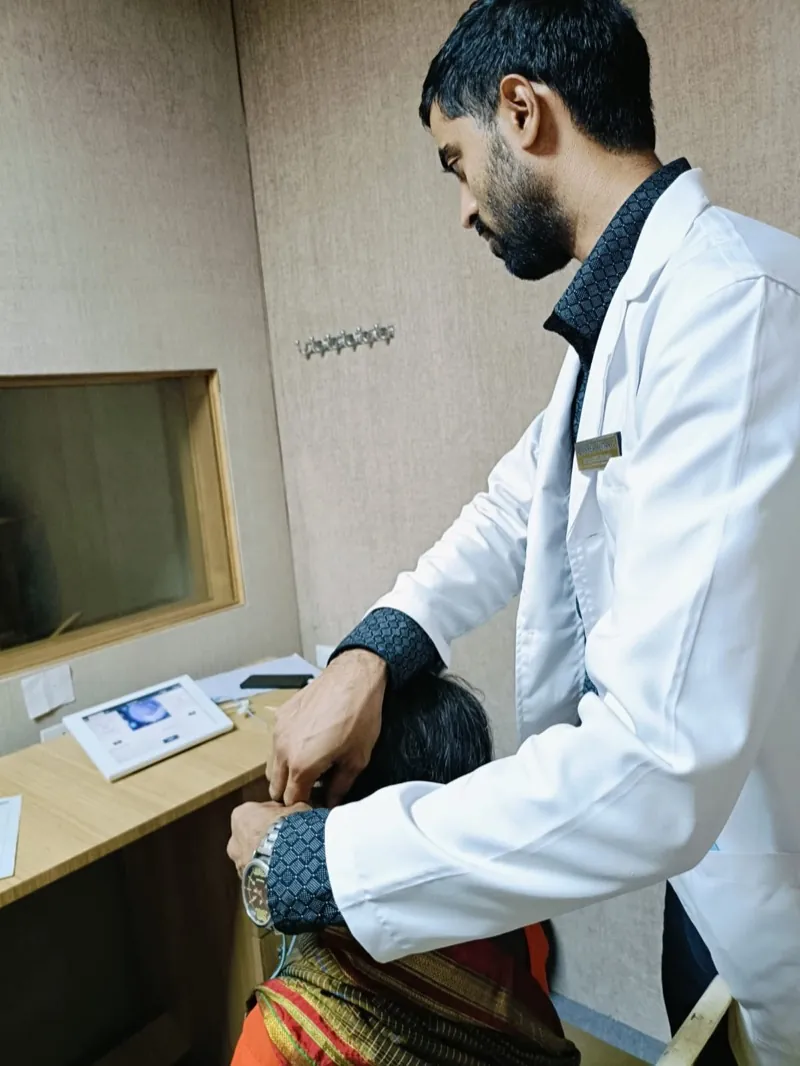
A pattern we see often at our Gandhinagar clinic: an elderly patient arrives with a “suddenly blocked” ear. Inside we find wax swollen by weeks of regular oiling — lovingly administered by family — sometimes with a fungal layer growing on top of the oil film. After cleaning, hearing returns instantly, and the only prescription needed is the hardest one: please retire the oil bottle from ear duty.
If an oiled ear in your house is itching, paining or hearing less, have it examined by an experienced audiologist in Gandhinagar rather than reaching for the bottle again — or describe the situation on WhatsApp (88776 72821) and we will guide you on how urgently it should be seen.