
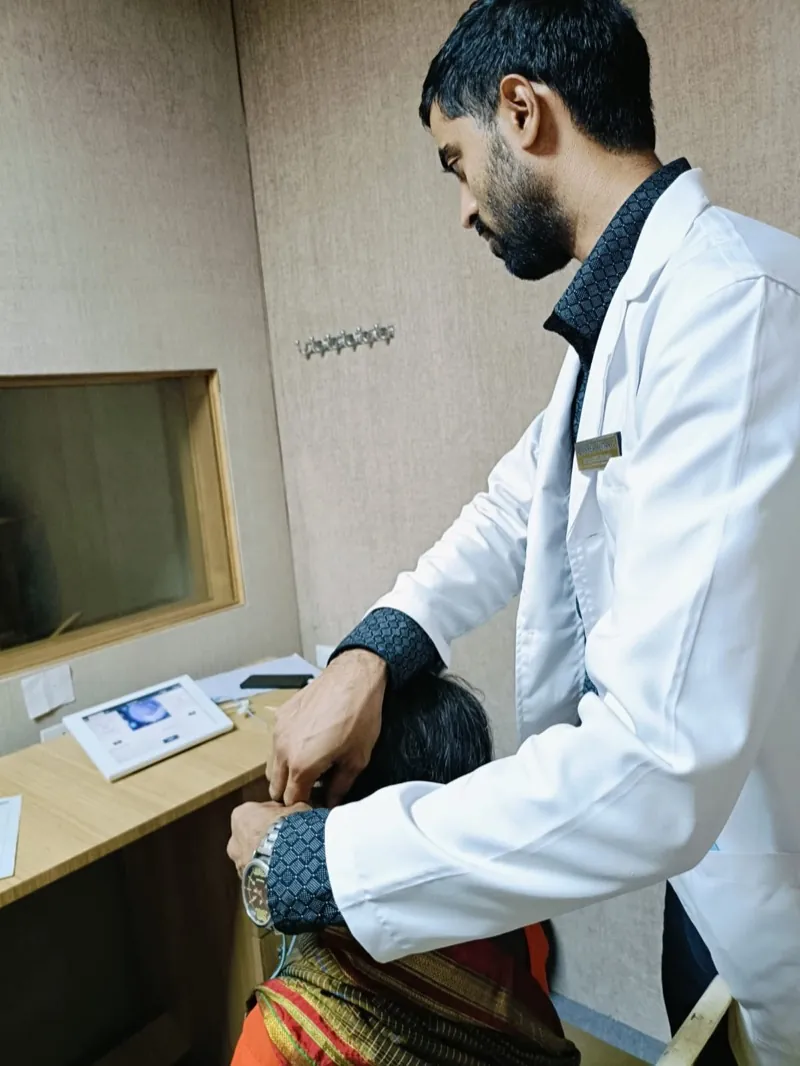
Many families in Gandhinagar live with significant hearing loss for years without realising that a single document — the disability certificate, now issued with a national UDID card — can pay for hearing aids, reduce travel costs, open education support and reserve job opportunities. Under the Rights of Persons with Disabilities Act 2016, hearing impairment is a recognised disability, and the process is more straightforward than most people fear. Here is how it works.
What does the 40 percent rule actually mean?
The law sets a threshold: a person with 40 percent or more assessed disability is a “benchmark” disabled person, and most concrete benefits attach at that line. For hearing, the medical board does not guess — it calculates. Your pure tone audiometry thresholds in the speech frequencies are averaged for each ear, converted to a percentage of impairment, and combined using the official formula, which gives the better ear far more weight than the worse ear.
In practical terms, a person needs a significant loss in both ears — broadly in the moderately-severe-or-worse territory — to cross 40 percent. This is why severe one-sided loss with a normal other ear usually computes below the benchmark, however disabling it feels in daily life. Before applying, it is worth having an audiologist run your numbers through the formula so you know where you stand; if you want to understand your own graph first, our explainer on how to read an audiogram report is the place to start.
Which audiology reports does the medical board need?
The board’s decision rests on objective, repeatable test reports:
- Pure tone audiometry (PTA) — the core document for adults and older children, showing air and bone conduction thresholds for both ears.
- Tympanometry — often requested to rule out a temporary middle-ear cause, since a treatable fluid problem should not be certified as permanent disability.
- BERA or ASSR — essential for babies, young children and anyone who cannot respond reliably; these estimate hearing levels without needing the patient’s cooperation.
Reports should be recent, on a proper letterhead with the audiologist’s RCI registration number, and should state thresholds clearly for each ear. The board typically repeats or verifies audiometry at the government facility on certification day — your private reports speed the process and support the file, they do not replace board testing. Knowing your type of hearing loss — conductive, sensorineural or mixed also matters, because the board treats permanent sensorineural loss differently from treatable conductive problems.
How do you apply for the UDID card step by step?
| Step | What happens | What you need |
|---|---|---|
| 1. Audiology work-up | PTA/tympanometry (BERA for children) at a qualified clinic | Reports with RCI number |
| 2. Online application | Register on swavlambancard.gov.in and fill the UDID form | Photo, signature, Aadhaar/ID, reports |
| 3. Medical board visit | Verification and board audiometry at the designated hospital | Acknowledgement slip, originals |
| 4. Certificate & card | Percentage finalised; e-certificate and UDID card issued | Track status on the portal |
The whole process is free of government fees. Timelines vary with board schedules — planning the audiology work-up and paperwork in one week, then attending the next available board day, is realistic for most Gandhinagar families.
What benefits does the certificate actually unlock?
This is not a symbolic document. With a benchmark (40 percent or more) certificate and UDID card, the concrete entitlements include: travel concessions on Indian Railways and Gujarat ST buses; education support — scholarships, exam accommodations such as extra time, and reservation in higher education; a 4 percent reservation in government jobs; income tax deductions under Section 80U for the person or 80DD for a supporting family member; and eligibility for free or subsidised hearing aids under the ADIP scheme. For children, the card also smooths access to early-intervention services and school accommodations.
A pattern we see often at our Gandhinagar clinic: parents delay applying for their child’s certificate for years because they fear the document will “label” the child — and in those years they pay full price for hearing aids, miss scholarship deadlines and fight school exam rules without the accommodation letter the card would have settled in minutes. The certificate does not define a child; it funds and protects them.
If you think you or a family member may cross the 40 percent line, start with a proper work-up by an audiologist in Gandhinagar — we prepare board-ready reports, calculate your expected percentage honestly, and tell you before you apply whether the application is worth your time.
WhatsApp for UDID test reports: 88776 72821