
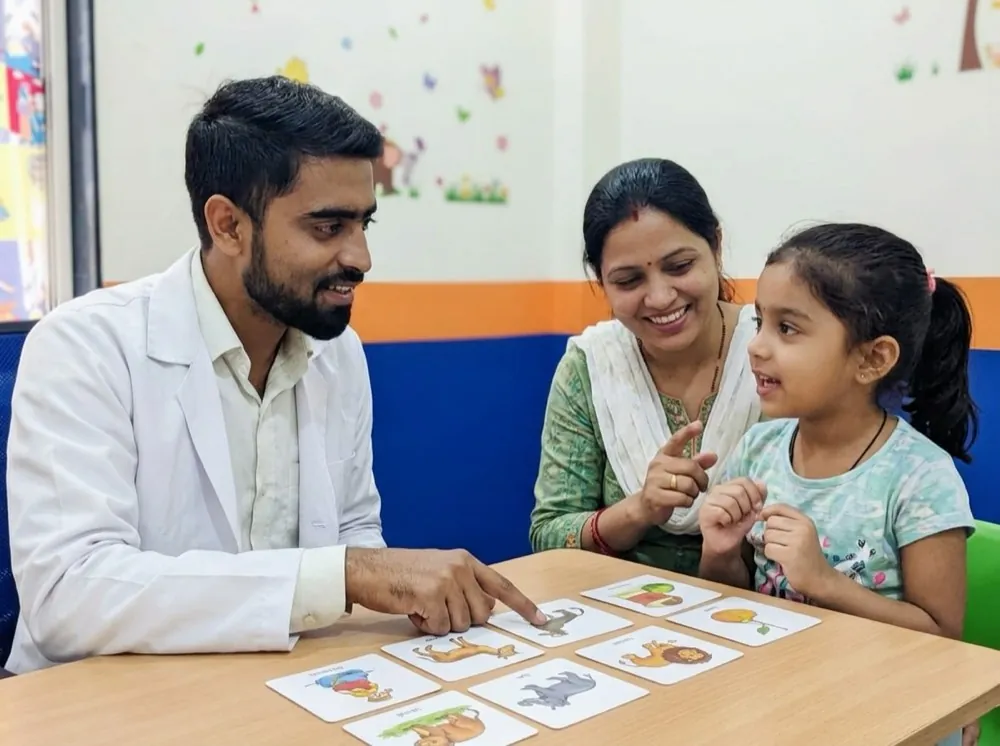
“He talks non-stop at home — but his teacher says she can't follow a word.” This is one of the commonest sentences spoken in our consultation room. The child is not late to talk; the words are there. The problem is articulation — how clearly individual sounds are produced. The good news: articulation problems are among the most fixable things we treat. The key is knowing what is normal at each age and what is not.
Why does my child speak plenty but stay un-understood?
Children learn the sound system of a language gradually, simplifying hard sounds into easier ones along the way. Saying tar for car (ક becoming ત), thapa for sapa, or skipping ર entirely (“oti” for રોટલી) are predictable, rule-based simplifications — every child uses them. Trouble starts when a child keeps using them past the age most children have dropped them, or uses unusual patterns that do not belong to normal development at all. Family members stop noticing because they have learnt the child's private code; strangers and teachers have not, which is why school complaints are often the first alarm.
Which sounds should be clear at which age?
Ages vary slightly between studies and between languages, but the sequence is remarkably stable. This chart blends English norms with what we observe for Gujarati-speaking children in clinic:
| Age (approx.) | Sounds usually mastered | Example words |
|---|---|---|
| By 3 years | પ, બ, મ, ન, હ, વ (p, b, m, n, h, w) | papa, ball, mumma, nahi |
| By 4 years | ક, ગ, ત, દ, ડ (k, g, t, d) | kela, gadi, tara, dada |
| By 5 years | ચ, જ, સ, શ, લ (ch, j, s, sh, l) | chakli, jal, sapa, shak, lal |
| By 6–7 years | ર, ળ, blends like સ્ત, પ્ર (r, retroflex ḷ, clusters) | rotli, baḷ, prashna, strawberry |
Two practical takeaways. First, a 3-year-old saying tar for car is on schedule; a 5-year-old doing the same is not. Second, ર and ળ are genuinely late sounds — do not panic about a 4-year-old's missing ર, and do not let anyone sell you therapy for it at that age without a fuller reason.
When is lisping normal and when is it a problem?
The classic lisp — સ coming out like થ, “thapa” for “sapa” — is common and developmentally acceptable up to around four-and-a-half to five years. Past that, it tends to stick without help, partly because the tongue habit gets stronger every day it is practised. A lisp that appears alongside tongue-thrust swallowing, constant open-mouth posture or thumb sucking deserves earlier attention, because the habit and the lisp feed each other.
Could hearing be the hidden cause?
This is the step families most often skip. A child pronounces only what they hear — and the sounds parents complain about most, સ and શ, are precisely the soft, high-frequency sounds that even a mild hearing loss erases first. Repeated colds and ear infections can leave fluid in the middle ear that muffles hearing for months without any pain. That is why a proper workup starts with a hearing test, not with the tongue. A pattern we see often at our Gandhinagar clinic: a five-year-old referred for “lazy speech” turns out to have fluid in both middle ears; once the ears are treated and a few months of therapy follow, the “laziness” disappears. If your child has a history of ear infections, our guide on blocked ears and hearing loss explains the mechanics.
How does articulation therapy work and what does it cost?
Therapy is systematic, not magic: the therapist teaches the correct tongue and lip placement for one target sound, drills it in syllables, then words, then sentences, then conversation — with five-minute daily practice at home between sessions. Most single-sound problems respond well within a few months. A full speech therapy assessment in Gandhinagar at our clinic checks hearing, oral structure and a complete sound inventory in one visit; therapy sessions then cost roughly Rs. 500–1,000 each. If you are unsure whether your child's overall speech is on track beyond clarity alone, start with our checklist of signs a child needs speech therapy.
WhatsApp us about your child's speech clarity