
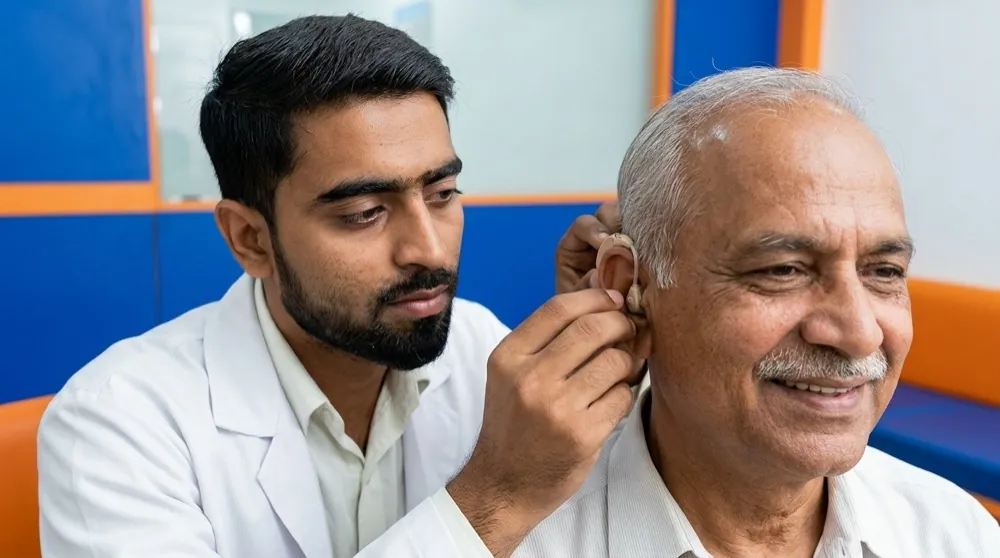
Search for any hearing aid model today and e-commerce listings appear above the clinics, often 20–30% cheaper. This is not a scare piece — the devices sold online are usually genuine, and the discount is genuine too. But a hearing aid is closer to a pair of prescription spectacles than to a Bluetooth speaker: the hardware is half the product. The other half is what happens to it after it comes out of the box. Here is exactly what that half contains, so you can judge the discount honestly.
What do you actually get in the online box?
You get the device, a charger or batteries, standard ear tips and a warranty card. What you do not get: a hearing test, programming of the aid to your specific loss, verification that the programmed sound is actually reaching your eardrum correctly, a custom ear mould if your ear needs one, and a person nearby who will adjust it in week two when something feels off. Most online aids ship with a generic preset, or at best a “self-fit” app tuned by your own answers to a smartphone hearing check.
What does programming actually do?
Hearing loss is a fingerprint — your audiogram shows exactly how much you have lost at each frequency, and it is rarely a flat line. Programming means setting the aid’s gain at every frequency to a validated prescription calculated from that audiogram: typically strong amplification for the high-pitched consonants you have lost, little for the lows you still hear. It also sets maximum output limits so loud sounds cannot hurt you, and configures noise reduction for your listening life. An unprogrammed aid running a generic preset can be simultaneously too loud where you do not need help and too quiet where you do — which users experience as “loud but not clear”.
What is real-ear verification and why does it matter?
Even a perfectly programmed aid delivers different sound in different ears, because every ear canal has its own size and acoustics — the same setting can land 10–15 dB apart in two different ears. Real-ear measurement (REM) places a thin probe microphone in the canal alongside the aid and measures what is actually arriving at your eardrum, then fine-tunes until it matches the prescription. It is the difference between assuming the aid is right and proving it. No online self-fit can replicate this step, because it requires a calibrated microphone physically inside your ear canal.
What happens after the sale: follow-up, servicing, repairs?
The first month decides whether an aid becomes part of daily life. New users almost always need fine-tuning visits — their own voice sounds odd, chewing is loud, the mosque or mandir hall echoes. A local clinic handles this in fifteen-minute visits; with an online purchase you are emailing support or couriering the device. The same applies to wax-blocked receivers, monsoon moisture damage and warranty claims — this matters in Gujarat’s climate, and our monsoon hearing aid care guide exists for a reason. Before buying anywhere, ask one question: who will service this device, and where?
| Online purchase | Clinic purchase | |
|---|---|---|
| Device price | Often 20–30% lower | Higher, includes services |
| Programming to audiogram | Generic preset or self-fit app | Done by audiologist from your test |
| Real-ear verification | Not possible remotely | Available at fitting |
| Fine-tuning & follow-up | Email/courier support | Walk-in visits, included |
| Repairs & warranty service | Courier to seller | Local, often same-day |
| Trial before commitment | Return policy, if any | Supervised trial period |
So when does buying online make sense?
Genuinely sometimes. If you are an experienced user replacing the exact model you already wear, with a recent audiogram and a clinic willing to program and verify the new device for a service fee, the online discount can be rational. Some clinics, including ours, will program externally purchased aids — though manufacturer warranty support may still route through the original seller, so check that before paying. Where online buying goes wrong is as a first hearing aid: a first-time user has no baseline, no mould, no habits, and needs the most hands-on month of their hearing aid life precisely when no hands are available.
A pattern we see often at our Gandhinagar clinic: a first-time user arrives with an aid bought online months earlier, worn only a handful of times because “it was too sharp”. On testing, the generic preset was over-amplifying frequencies they barely needed. After proper programming and a real-ear check, the same device becomes wearable — the hardware was never the problem; the missing services were.
If you are weighing an online price against a clinic quote, bring us both numbers — WhatsApp 88776 72821 — and read our breakdown of hearing aid prices in Gandhinagar first. Then visit our hearing aid centre in Gandhinagar for a trial, and judge the difference with your own ears.