
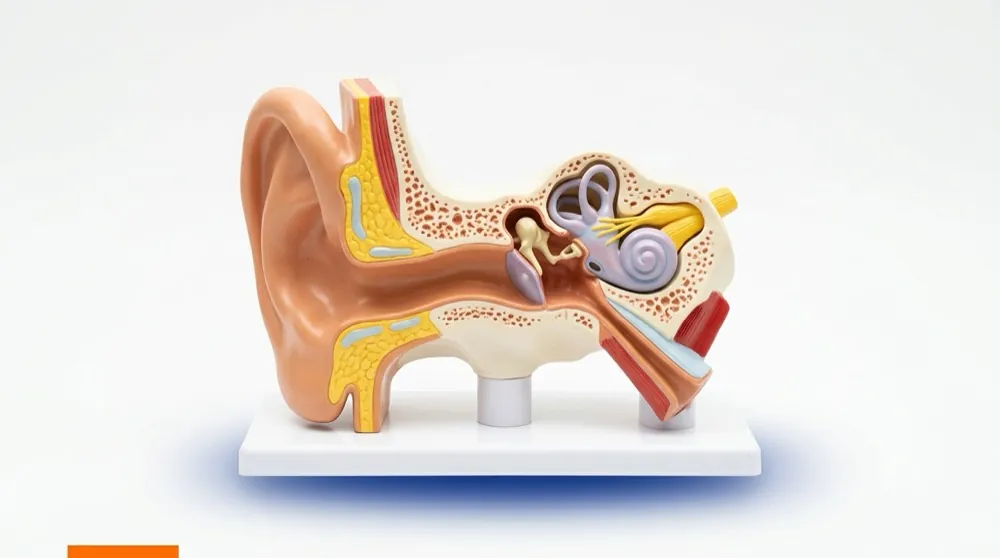
Most ear problems send one symptom at a time. Meniere’s disease sends three together — spinning vertigo, ringing tinnitus and a blocked, full feeling in one ear — and then, cruelly, withdraws them for weeks as if nothing happened. That come-and-go pattern is exactly why it gets missed, mislabelled as “gas”, “cervical” or “weakness”, and why the hearing in the affected ear quietly erodes while nobody is measuring it. Here is what the package actually is, and how it is managed in practice.
What does a Meniere’s attack actually feel like?
A classic attack announces itself: the ear feels full and under pressure, the ringing or roaring swells, hearing goes dull — and then the world starts to spin. Not a momentary wobble, but genuine rotation lasting anywhere from 20 minutes to several hours, often with nausea, vomiting and cold sweat. The person usually has to lie still until it passes, then feels wrung out for a day. Between attacks there may be weeks or months of complete normality. If you have had two or more episodes fitting this description, with ear symptoms on the same side each time, Meniere’s belongs on the table — and so does a structured workup, since BPPV, vestibular migraine and other mimics need ruling out. Our guide to BPPV — the position-triggered spinning shows how different that pattern looks.
Why do vertigo, tinnitus and ear fullness come as a package?
The inner ear is one fluid-filled structure with two departments: the cochlea, which hears, and the balance canals, which sense motion. In Meniere’s disease the fluid (endolymph) builds up under too much pressure — doctors call it endolymphatic hydrops. Because both departments share the same plumbing, the pressure hits hearing and balance at once: fullness from the pressure itself, tinnitus and dulled hearing from the stressed cochlea, and vertigo when the balance canals misfire. One mechanism, three symptoms — that is why they arrive as a package, and why treating only the “chakkar” misses the disease.
Does the low-salt diet really help?
Yes — it is the single most useful thing in your own hands, because salt makes the body retain fluid, and this is a fluid-pressure disease. The practical targets in an Indian kitchen are not the dal and sabzi, which you can simply salt modestly, but the salt bombs around them: papad, athanu (pickles), farsan, packaged namkeen, sev, chutneys with black salt, bakery items, sauces and instant noodles. Two rules matter more than any number. First, consistency beats severity — a steady, moderate salt intake spread evenly across meals does more good than a salt-free Monday followed by a wedding-buffet Saturday, because it is the swings in fluid balance that provoke attacks. Second, drink water regularly through the day; dehydration-rehydration cycles are another swing. Many patients also find caffeine and alcohol reduction, regular sleep and stress management visibly lengthen the gap between attacks.
Why must hearing be tested between attacks?
This is the part most patients are never told. In early Meniere’s, hearing drops during an attack and recovers afterwards — so people assume no harm was done. But with each cycle the recovery is slightly less complete, and over the years the fluctuating loss hardens into a permanent one, typically starting in the low frequencies. The disease’s long-term damage is measured in hearing, not in vertigo. That is why serial pure tone audiometry (Rs.300–800, repeated every few months or after any significant attack) is part of proper care: it tracks whether treatment is protecting the ear, catches any involvement of the second ear early, and tells us exactly when a hearing aid would start helping.
| Stage | Vertigo attacks | Hearing between attacks |
|---|---|---|
| Early | Occasional, often dramatic episodes with fullness and ringing | Returns to near normal between episodes |
| Middle | Clusters of attacks separated by quiet months | Low tones stay dull; fluctuation continues |
| Later | Spinning often eases, leaving unsteadiness | Permanent loss; hearing aids usually help |
What does treatment look like in practice?
Management is layered: the diet and lifestyle measures above; medication during and between attacks prescribed by your ENT doctor (commonly betahistine — never self-prescribed); vestibular rehabilitation exercises to retrain balance between episodes; hearing aids once the loss stops recovering; and, for the small minority with resistant attacks, injection-based ENT procedures. A pattern we see often at our Gandhinagar clinic: a person who has endured years of “chakkar attacks” treated symptom by symptom, whose audiogram shows the telltale low-frequency dip on one side — the first time anyone has connected their vertigo, their ringing and their dull ear into a single, manageable diagnosis. Once the package has a name, the panic goes out of it.
If this attack pattern sounds familiar, start with a structured vertigo assessment in Gandhinagar — positional testing plus audiometry on the same visit, so both halves of the inner ear are checked together.
WhatsApp us about your vertigo attacks