
Half the people who walk into our clinic asking about hearing aids begin with the same sentence: “I want the one nobody can see.” Completely fair — nobody owes the world a view of their hearing aid. Invisible-in-canal (IIC) and completely-in-canal (CIC) aids genuinely deliver that. But they are the most selective devices we fit, and a wrong choice means money spent on an aid that whistles, clogs or sits in a drawer. This guide is the honest eligibility check, before you travel anywhere.
What counts as an “invisible” hearing aid?
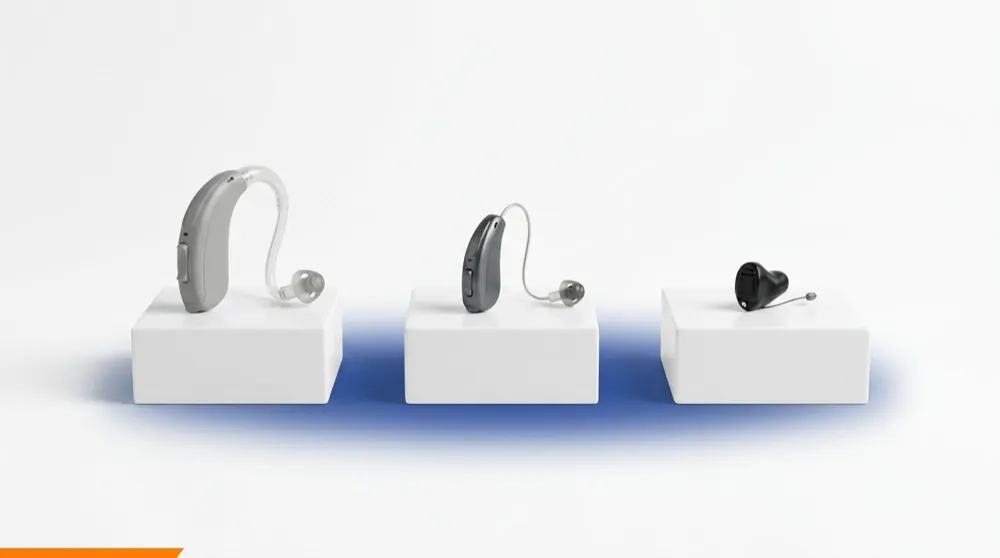
These are custom-moulded devices, built from an impression of your ear canal, that sit partly or fully inside it:
| Style | Where it sits | Visibility | Suits hearing loss |
|---|---|---|---|
| IIC (invisible-in-canal) | Deep in the canal, past the first bend | Practically invisible | Mild to moderate |
| CIC (completely-in-canal) | Inside the canal, faceplate at the opening | Visible only on close look | Mild to moderately severe |
| ITC (in-the-canal) | Canal plus part of the outer bowl | Partly visible | Mild to severe |
| RIC (receiver-in-canal) | Tiny unit behind the ear, thin wire into canal | Very discreet, not invisible | Mild to severe/profound |
Who is a good candidate for IIC or CIC?
- Mild to moderate hearing loss (CIC stretches to moderately severe in some ears) confirmed on a recent audiogram.
- An adult ear canal that is wide and deep enough — only the ear impression can confirm this; eyeballing cannot.
- A dry, healthy canal with no recurring infection or discharge.
- Reasonable finger dexterity and eyesight for tiny batteries and wax guards.
- Realistic expectations: invisibility costs you some features, not just visibility.
Who shouldn’t wear an invisible hearing aid?
This is the part a commission-driven counter will not tell you, and it is exactly what saves you a wasted trip chasing the wrong device:
- Severe or profound hearing loss. The tiny shell cannot house enough amplification; pushed hard, it feeds back (whistles) constantly. You will hear better — and look just as discreet in real life — with a modern RIC.
- Narrow, sharply bent or very short ear canals. Some ears simply cannot seat the device deep enough to hide it or hold it stable. This is anatomy, not budget.
- Heavy wax producers or discharging ears. The speaker outlet sits millimetres from the wax it must survive. If your ears block often (see our guide on ear wax and hearing loss), expect frequent dead-aid moments and repair runs.
- Children and teenagers. A growing canal outgrows a custom shell within months.
- Arthritis, tremor or low vision. Size 10 batteries and thread-like removal cords test even young fingers.
- Heavy phone and TV streamers. Many IIC models drop Bluetooth to save space — if streaming matters to you, say so before choosing the style.
What are the trade-offs nobody mentions in the showroom?
Even for perfect candidates, invisibility has a price beyond the bill. The size 10 battery lasts roughly three to five days, the smallest of any style. Directional microphones — the feature that helps most in noisy Gujarati family functions — are limited or absent in the smallest shells. Your own voice can sound boomy at first (the “occlusion effect”) until the vent and fitting are tuned. And because the entire device lives in the warm, waxy canal, servicing intervals are shorter than for behind-the-ear styles. None of these are dealbreakers; all of them deserve to be said out loud before billing, not after.
A pattern we see often at our Gandhinagar clinic: a person in their fifties arrives determined to buy an IIC their colleague wears, but their audiogram shows a severe high-frequency loss and the otoscope shows a narrow, waxy canal. Instead of selling the wrong device, we fit a slim RIC with a deep-fit dome — and at the next family wedding, nobody notices it, which was the actual goal all along.
How do you find out if your ear qualifies?
Three things decide it, and all three happen in one visit: a fresh audiogram (degree and shape of loss), an otoscopic look at the canal (wax, width, health), and a silicone ear impression (the final word on whether an IIC can physically sit deep enough). At our invisible hearing aid fitting in Gandhinagar we do all three before recommending any style, and we will tell you plainly if invisible is the wrong answer for your ear — along with what the right one costs (our hearing aid price guide breaks down every range).
Want a quick opinion before visiting? WhatsApp us at 88776 72821 with your audiogram if you have one — we will tell you honestly whether IIC/CIC is worth pursuing.